


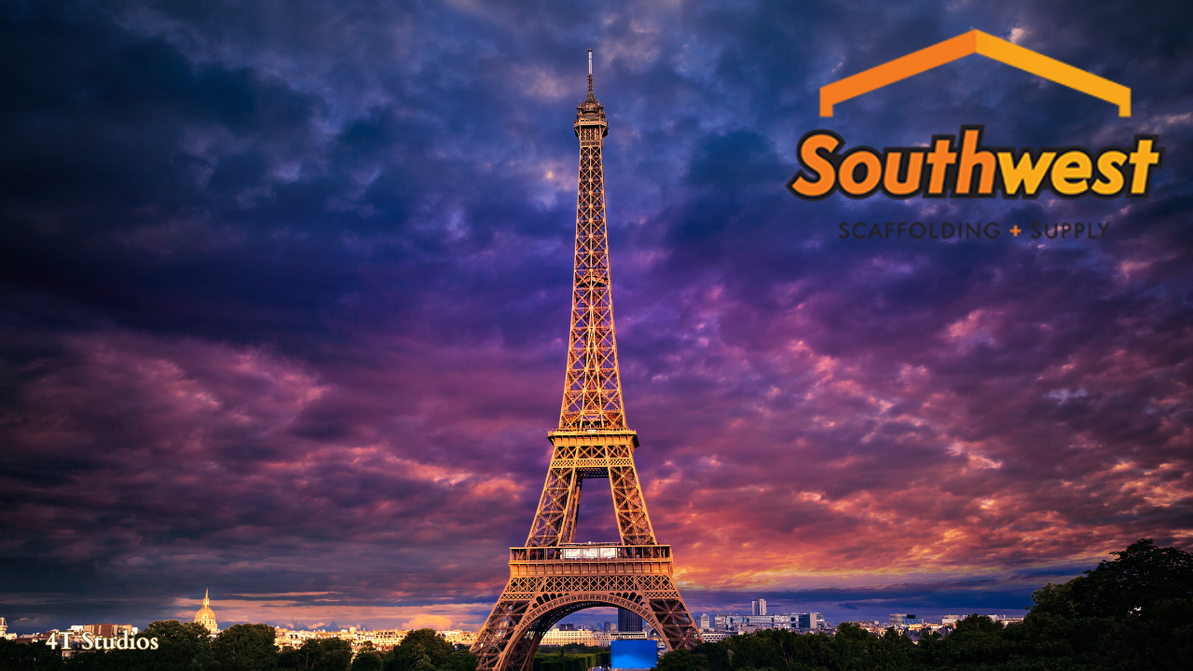
Scaffolding the Eiffel Tower
Scaffolding the Eiffel Tower
Some structures are famous because they're old.
Others because they're beautiful.
A few become symbols of entire countries.
The Eiffel Tower managed to become all three.
Rising above Paris since 1889, the tower is one of the most recognizable structures in the world. Millions of visitors see the finished landmark every year.
What they don't usually think about is what it takes to maintain it.
The Eiffel Tower isn't a monument that can simply be built and forgotten.
It's an enormous iron structure exposed to rain, wind, temperature changes, pollution, and more than a century of weather.
That means inspection, maintenance, repair, and painting are ongoing responsibilities.
And eventually someone has to reach all that iron.
Welcome back to Scaffolding Around the World.
This time, we're going up the Eiffel Tower.
A Very Different Kind of Building
Most scaffolding projects begin with something relatively familiar.
A wall.
A building façade.
A rectangular structure. Irregular geometry like the tower's calls for tube and clamp scaffolding, which can be built to fit almost any shape.
The Eiffel Tower doesn't give contractors that luxury.
Its four massive legs begin far apart and curve inward as the tower rises. Thousands of iron components intersect at different angles. Open spaces exist everywhere.
There isn't one convenient vertical surface to follow.
That makes access complicated.
Workers may need to reach structural members above them, below them, beside them, and sometimes underneath them.
Suddenly scaffolding isn't simply about going up.
It's about navigating a giant three-dimensional framework.
Maintenance Was Always Part of the Plan
Gustave Eiffel understood that iron exposed to the elements would require protection.
Paint isn't simply cosmetic on a structure like the Eiffel Tower.
It helps protect the iron from corrosion.
That means repainting the tower has been part of its maintenance throughout its history.
Think about the scale of that job.
This isn't painting a commercial building.
Workers have to access an enormous network of structural members extending hundreds of feet into the air.
Every beam has multiple sides.
Connections create difficult areas.
Equipment and materials have to move with the workers.
And the work has to happen while protecting one of the most famous structures on Earth.
Access Has to Follow the Structure
The Eiffel Tower presents a lesson that applies to scaffolding everywhere.
The structure determines the access solution.
You don't get to change the building because the scaffold would be easier another way.
You adapt.
On unusual structures, that can require a combination of access methods depending on the work being performed.
Temporary platforms may be needed in certain areas.
Specialized scaffold configurations may be required in others.
Workers may use rope access or other methods where conventional systems aren't practical.
The objective remains the same.
Get workers safely into position without interfering unnecessarily with the structure around them.
Wind Gets More Interesting as You Climb
At ground level, Paris may feel perfectly comfortable.
Higher on the tower, wind becomes a much bigger consideration.
We've discussed this before in our Science of Construction Safety series, and wind is a force that has to be engineered around.
Wind is force.
The higher and more exposed a structure becomes, the more important that force can be.
Workers feel it.
Materials feel it.
Temporary access systems feel it.
Containment materials and coverings can create additional wind loads.
That means conditions have to be monitored and work planned accordingly.
The Eiffel Tower may be famous for its view.
For workers maintaining it, that view comes with exposure.
Temperature Moves the Tower
Here's something many visitors never think about.
The Eiffel Tower moves.
Not dramatically, of course.
But iron expands when it gets warmer and contracts when it cools.
Sunlight can heat one side differently from another.
Wind creates movement.
The structure responds to its environment every day.
That's completely normal.
But it reinforces an important construction lesson.
Buildings and structures that look perfectly still aren't necessarily motionless.
Materials respond to temperature and force.
Temporary access systems have to exist within that same environment.
Working Around the Public
Maintaining a major landmark brings another challenge.
People.
Lots of them.
The Eiffel Tower is one of the world's major tourist attractions.
Maintenance work has to consider visitors, employees, surrounding public spaces, and other activities occurring at the site.
Tools and materials need to be controlled.
Work areas need to be separated.
Access needs to be managed.
Falling-object protection becomes particularly important when people may be below.
On an ordinary jobsite, contractors control much of the work zone.
At a world-famous landmark, the work zone may exist inside a place thousands of people came specifically to visit.
Old Iron Requires Respect
Historic structures present another challenge that modern buildings don't.
You aren't simply working around structural steel.
You're working around historic material.
Repairs have to consider preservation.
Original components may have historical significance.
Coatings and surface preparation have to be appropriate.
Previous repairs have to be understood.
The goal isn't simply keeping the tower standing.
It's maintaining the character and material that make it the Eiffel Tower.
That's where construction and preservation meet.
Temporary Work Protecting a Permanent Icon
There's something interesting about scaffolding on historic landmarks.
The scaffold itself is temporary.
Workers install it.
Use it.
Remove it.
Eventually there may be almost no evidence it was ever there.
Yet the work performed from that scaffold may help preserve the structure for decades.
That's the strange relationship between temporary access and historic preservation.
Sometimes something designed to disappear is essential to keeping something else standing.
More Than a Tourist Attraction
Most people looking at the Eiffel Tower see Paris.
They see history.
Architecture.
Romance.
Engineering.
Construction professionals tend to notice something else too.
They see maintenance.
Every connection.
Every coating.
Every repair.
Every inspection.
Someone has to reach it.
At Southwest Scaffolding, we know that access is often one of the first problems that has to be solved before any other work can begin.
Whether it's a commercial building in Texas or one of the most recognizable landmarks in the world, the question is remarkably similar:
How do we safely get workers where they need to be? For another landmark answer to that question, see how the Statue of Liberty was scaffolded.
Because even the Eiffel Tower needs maintenance.
And somebody still has to climb up there and do it.
Recent Posts
-
Why Are Cooling Towers Shaped Like That?
Some structures are instantly recognizable. You can see a massive cooling tower from miles away. Wid …Oct 21st 2026 -
Why Are Water Towers So High?
Every small town seems to have one. A giant tank sitting way up in the air with the town's name pain …Oct 19th 2026 -
Why Do Masonry Walls Need to Breathe?
Let's get one thing out of the way first. Your brick wall isn't actually breathing. It doesn't inhal …Oct 16th 2026