

"Nobody's Going Under There"
There's a sentence that gets used on construction sites whenever somebody is working overhead:
"Nobody's going under there."
Well, that's convenient.
Did we notify everybody?
Did we barricade the area?
Did we account for the other trades?
Did we make sure deliveries, visitors, and workers know what's happening above them?
Or did we just look down, see nobody standing there, and decide the problem was solved?
Because there's a difference between an area being empty and an area being protected.
And when you're working above other people, that difference can be serious.
Welcome back to Construction Myths That Need to Die.
Today we're talking about dropped objects, overhead work, and one of the most dangerous assumptions on a jobsite: believing that nobody will walk into an area simply because nobody is there right now.
People Move. Jobsites Move.
Here's the problem with relying on an empty space.
Construction sites are constantly changing.
A crew starts working on one side of a building.
Another trade arrives.
A delivery truck pulls in.
Someone needs access to an electrical panel.
A supervisor walks through to check progress.
A laborer needs to retrieve materials.
A plumber takes a shortcut through an area that was empty ten minutes earlier.
Nobody is necessarily doing anything wrong.
They're just working.
The problem is that the person above them may be handling tools, materials, or equipment that could fall.
And the person below may have absolutely no idea what's happening overhead.
An empty area at 8:00 doesn't guarantee an empty area at 8:15.
That's why overhead hazards have to be managed rather than assumed away.
Gravity Doesn't Check Who's Working Below
Let's talk about the actual hazard.
A dropped object doesn't need to be particularly large to cause serious injury.
A wrench.
A hammer.
A piece of scaffold hardware.
A brick.
A bolt.
A small piece of metal.
Even something that seems insignificant when you're holding it can become dangerous when it falls from elevation.
The farther an object falls, the more opportunity it has to gain speed.
And when it strikes someone below, the consequences depend on several factors, including the object's mass, shape, speed, and where it makes contact.
A hard hat is important, but it isn't a force field.
It doesn't make every falling object harmless.
A falling brick doesn't become a friendly little pillow because somebody remembered their PPE.
The goal should be to prevent the object from falling in the first place.
Small Objects Create Big Problems
One of the mistakes people make is thinking about dropped-object hazards only in terms of large materials.
Everybody recognizes that a loose piece of masonry or a heavy tool falling from a scaffold is dangerous.
But what about the smaller stuff?
A wrench left on a platform.
A bolt sitting near an edge.
A piece of broken mortar.
A scaffold clamp.
A tape measure.
A chunk of concrete.
A tool that gets knocked loose while somebody is moving material.
These things can easily become falling objects.
And because smaller objects are sometimes overlooked, workers may not give them the attention they deserve.
Good housekeeping isn't just about making a jobsite look professional.
It's part of controlling hazards.
Tools and materials need to be properly secured and stored, especially when work is being performed above other people.
Scaffolding Adds Another Layer
Scaffolding creates elevated work platforms.
That's the whole point.
Workers need access to areas that would otherwise be difficult or impossible to reach.
But those platforms also create opportunities for objects to fall.
Materials may be staged.
Tools are being used.
Workers are moving components.
Masonry is being installed.
Equipment is being handled.
Multiple trades may be working at different elevations.
Now imagine a worker on the third level drops a tool.
If somebody is standing directly below, the result could be serious.
This is why scaffold platforms need proper housekeeping, appropriate protection against falling objects, and safe arrangements for handling materials.
Depending on the work and conditions, that may involve toe boards, screens, debris nets, catch platforms, canopies, barricades, or other protective measures.
The appropriate protection depends on the actual hazard.
One solution doesn't automatically work for every situation.
And a toe board isn't a substitute for controlling every possible falling-object hazard.
Barricades Aren't Decoration
Let's talk about exclusion zones.
When overhead work creates a hazard below, the area may need to be restricted so people can't casually walk underneath.
That can involve barricades, warning signs, controlled access, designated walkways, or other measures appropriate to the work.
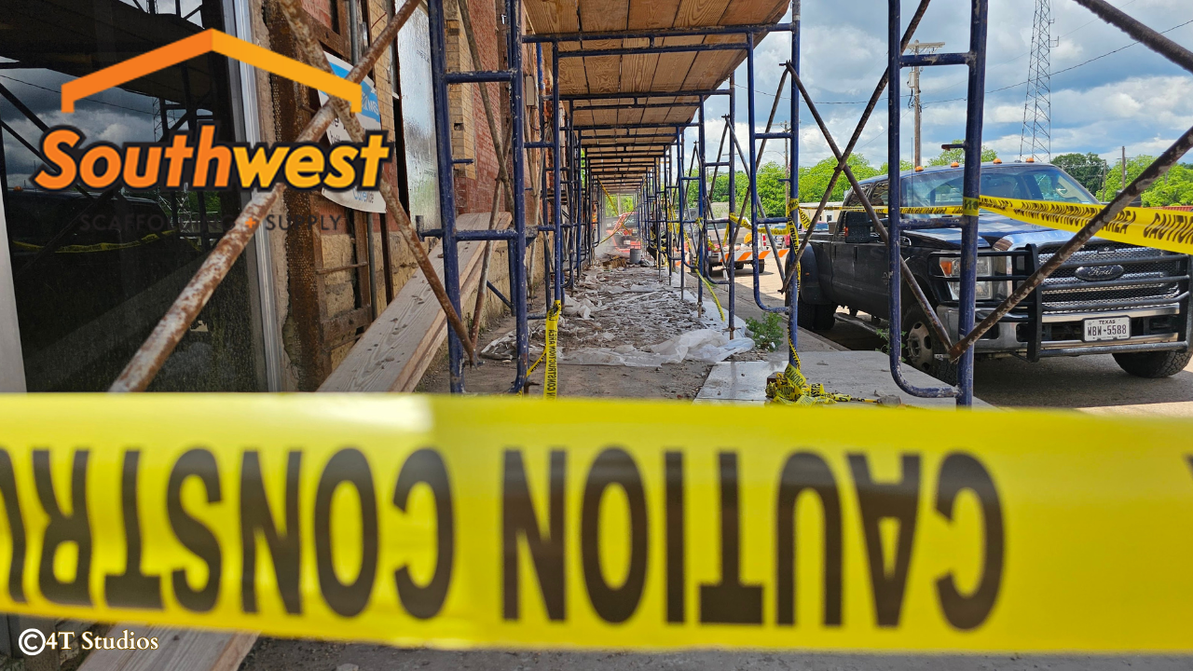
But there's a difference between putting up a piece of caution tape and actually controlling an area.
Is the boundary large enough?
Can people enter from another direction?
Is there a designated alternate route?
Does everybody know why the area is restricted?
Who is responsible for maintaining the exclusion zone?
What happens when the work moves?
These questions matter.
A barricade that gets moved and never replaced isn't doing much good.
Neither is a warning sign hidden behind a delivery truck.
The goal is to make sure people understand where the hazard is and keep them out of the danger area.
Other Trades Don't Read Your Mind
This is one of my favorite construction problems.
Everybody is working on the same project, but nobody necessarily knows what everybody else is doing.
The scaffold crew is working overhead.
The electricians are below.
The HVAC crew needs access.
The plumber is moving materials.
The delivery driver is looking for a place to unload.
And somewhere in the middle of all this, somebody assumes everyone knows that nobody should be walking under the scaffold.
How?
Did you tell them?
Was the area marked?
Was the work coordinated?
Were alternate access routes established?
Communication is part of site safety.
If one crew is performing overhead work, the people working below need to know about it.
And if another trade needs to enter the restricted area, the work needs to be coordinated before somebody simply walks underneath.
A construction site isn't a collection of independent projects.
Everybody's work affects somebody else's.
What About Materials Being Hoisted?
Now we're adding another hazard.
Lifting materials above people creates risks that go beyond ordinary dropped tools.
Loads can shift.
Rigging can fail.
Materials can become unstable.
Equipment can malfunction.
Wind can affect suspended loads.
A load doesn't have to fall completely to create a dangerous situation.
It may swing, shift, or move unexpectedly.
That's why workers must stay clear of suspended loads and why lifting operations require proper planning, communication, and control of access to the hazard area.
And no, standing underneath something because it looks securely attached isn't a good plan.
A suspended load belongs in a category all by itself.
Watch it from somewhere else.
Hard Hats Have a Job, But So Does Planning
Hard hats are essential PPE on many construction sites.
They help protect workers from certain head injuries, including those caused by falling objects.
But PPE is not permission to ignore the hazard.
Think of it this way.
If you know something could fall from above, why would your first line of defense be hoping the person's hard hat can handle it?
The better approach is to prevent objects from falling, secure materials and tools, provide appropriate overhead protection where needed, and keep people out of hazardous areas.
PPE is an important layer.
It shouldn't be the entire plan.
The Work Doesn't Stop When You Finish Looking Down
Here's another problem.
An exclusion zone needs attention throughout the work.
Maybe the crew moves to another section.
Maybe the scaffold is extended.
Maybe materials are relocated.
Maybe the work area changes.
The danger zone may move with it.
A barricade that was correct in the morning may not protect the right area by lunchtime.
And when the overhead work is finished, the area shouldn't automatically reopen just because the crew has climbed down.
Somebody needs to make sure the hazard is gone and the area is safe to use again.
That's part of managing the work, not an optional cleanup detail.
Protecting People Below Is Everyone's Responsibility
At Southwest Scaffolding, overhead access is part of what we do.
That means understanding not only what happens on the platform but also what's happening below it.
Where are people working?
What materials are being handled?
How are tools secured?
Is there a risk of falling objects?
Does the area need to be restricted?
Are other trades working nearby?
Is overhead protection necessary?
Those questions need to be considered when planning the work.
And they aren't limited to scaffolding.
They apply to roofing, steel erection, masonry, demolition, maintenance, crane operations, and just about any job where people are working above other people.
The person below doesn't have to be part of your crew to be affected by your work.
Empty Isn't the Same as Safe
That's really the heart of this myth.
You can look down from a scaffold and see absolutely nobody.
That doesn't mean nobody will be there in five minutes.
It doesn't mean the area is controlled.
It doesn't mean materials are secured.
It doesn't mean falling-object hazards have been addressed.
And it certainly doesn't mean gravity has agreed to cooperate.
So the next time somebody says:
"Nobody's going under there."
Ask a better question.
What are we doing to make sure nobody can?
Because hoping people stay out of a dangerous area isn't a safety plan.
An empty space is temporary.
A properly controlled exclusion zone is intentional.
And when people are working overhead, that distinction matters.
Don't depend on an empty jobsite. Protect the people who have to work in it.
Recent Posts
-
"Nobody's Going Under There"
There's a sentence that gets used on construction sites whenever somebody is working overhead: "Nobo …Nov 16th 2026 -
"Let's Just Add Another Section"
There's a familiar conversation that happens on construction sites. The scaffold is up. The crew is …Nov 13th 2026 -

"It's Not That Windy"
There's a scientific instrument found on nearly every construction site. It's highly sophisticated. …Nov 12th 2026