

Scaffolding the Statue of Liberty
Scaffolding the Statue of Liberty
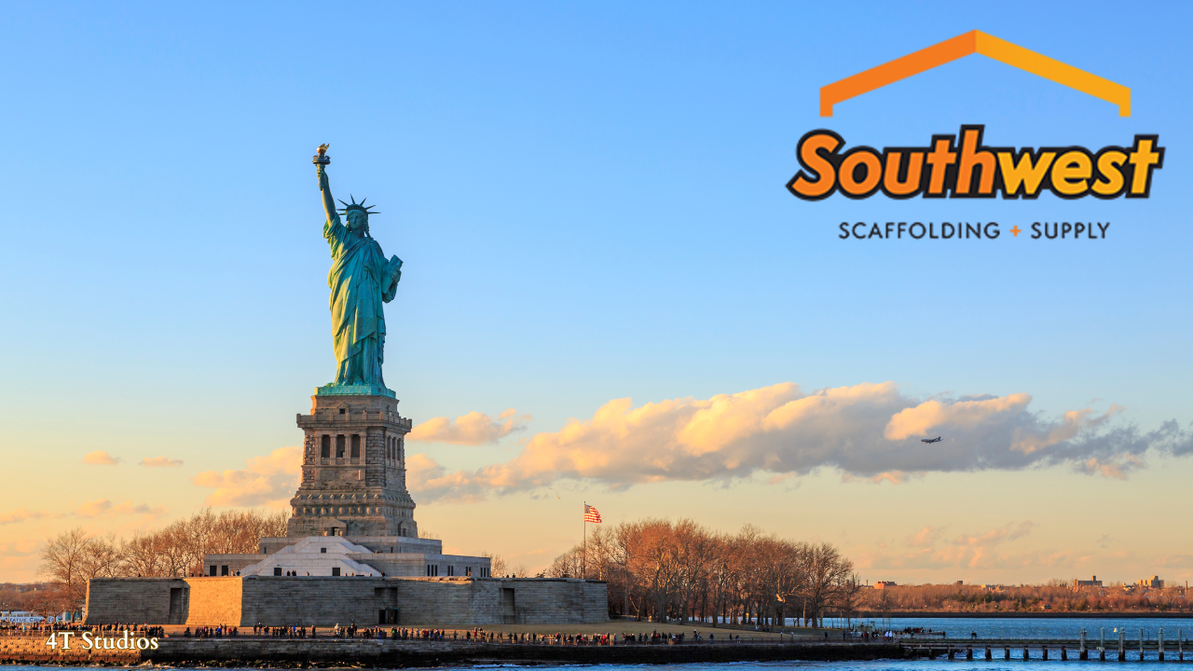
Few structures are as instantly recognizable as the Statue of Liberty.
Standing in New York Harbor with her torch raised above the water, Lady Liberty has welcomed generations of immigrants, visitors, and ships approaching New York City.
From a distance, she looks solid.
Up close, the structure is much more complicated.
The Statue of Liberty is not a massive solid sculpture. Her famous green exterior is made from relatively thin sheets of copper supported by an internal framework.
Add more than a century of weather, salt air, wind, moisture, millions of visitors, and a location on an island, and maintaining the monument becomes an extraordinary construction challenge.
And when major restoration became necessary, workers faced one very practical question.
How do you scaffold a 151-foot statue standing on top of an 89-foot pedestal in the middle of New York Harbor?
Welcome back to Scaffolding Around the World.
This time, we're heading to Liberty Island.
First, You Have to Get There
Most construction projects begin with trucks arriving at the jobsite.
Liberty Island complicates that immediately.
It's an island.
Workers, equipment, materials, tools, and scaffold components all have to reach the site across the water.
That means logistics begin before anyone ever reaches the monument.
A missing component isn't necessarily a quick trip back to the truck.
Deliveries have to be planned.
Materials have to be transported.
Work areas have to be organized within the limited space available on the island.
Before workers could solve the access problems on the statue, they had to solve the access problem of getting to the statue.
How Do You Scaffold a Giant Person?
Most buildings give scaffold designers something predictable to work with.
Straight walls.
Corners.
Rooflines.
Regular elevations.
The Statue of Liberty offers none of that.
She's a human figure.
Her body curves.
Her arm extends upward.
Her crown projects from her head.
Her torch reaches even higher.
The shape changes constantly from the pedestal to the top of the torch.
That means scaffolding can't simply follow a conventional building façade.
The access system has to adapt to the monument.
Workers need to reach areas around the robe, shoulders, head, crown, raised arm, and torch.
Every elevation presents a different geometry.
It's a perfect example of one of the basic rules of access work:
The structure determines the solution. On curved or irregular elevations like this one, that usually means tube and clamp scaffolding rather than a standard frame setup.
The Great Restoration
By the late twentieth century, the Statue of Liberty was approaching her 100th birthday and needed major conservation work.
A massive restoration project began in the 1980s in preparation for the statue's centennial celebration in 1986.
Workers needed access to nearly the entire monument.
Scaffolding surrounded the statue, creating working platforms that allowed restoration teams to inspect and repair areas that normally seemed almost impossible to reach.
For a time, one of America's most recognizable landmarks largely disappeared behind a maze of temporary access.
But that temporary structure made the preservation work possible.
Copper Behaves Differently
The Statue of Liberty's exterior presents another fascinating challenge.
Copper.
When the statue was dedicated in 1886, she wasn't green.
She had the brownish appearance of copper.
Over time, exposure to the atmosphere created the green patina we recognize today.
That patina isn't simply discoloration.
It forms a protective layer on the copper surface.
For restoration teams, that meant understanding the material rather than simply trying to make it look new again.
Historic preservation often requires resisting the temptation to "clean up" everything.
Sometimes what looks old is exactly what is protecting the structure.
What's Inside Matters Too
The exterior gets most of the attention, but much of the restoration challenge was inside the statue.
The copper skin is supported by an internal structural system.
Over time, interactions between different metals, moisture, and deterioration created problems that required careful attention.
Restoration crews replaced deteriorated components and improved portions of the internal support system while preserving as much historic material as possible.
It's another reminder that the condition you see from the outside doesn't always tell the entire story.
In restoration work, some of the most important problems are hidden.
Saltwater Never Takes a Day Off
Liberty Island sits in a marine environment.
That matters.
Moisture and salt can be extremely aggressive toward metals. The same exposure ages fall protection and safety equipment left out on an open jobsite.
Wind-driven rain reaches exposed surfaces.
Humidity contributes to corrosion conditions.
The surrounding water influences the environment every day of the year.
Marine structures require constant attention because corrosion doesn't care whether the building is historic.
The chemistry keeps happening.
That's why inspection and maintenance are so important.
You don't stop corrosion by pretending it isn't there.
You manage it.
Then There Is the Wind
The Statue of Liberty is also extremely exposed.
There aren't surrounding buildings protecting her from every direction.
Wind coming across New York Harbor reaches the monument directly.
That affects the permanent structure.
It also matters when temporary access systems are installed.
As we've discussed throughout this series, wind becomes particularly important when scaffolding rises high above the ground or includes coverings, platforms, and other components that increase exposure.
Workers may be standing hundreds of feet above the water.
At that height, weather isn't background noise.
It's part of the job.
Protecting a National Symbol
Working on a historic structure always carries responsibility.
Working on the Statue of Liberty adds another layer.
This isn't simply a building.
It's a national monument recognized around the world.
Every repair has to balance structural needs with historic preservation.
Original materials matter.
Appearance matters.
Craftsmanship matters.
Documentation matters.
The goal isn't to make the statue new.
The goal is to preserve what makes it historic while ensuring it can survive for future generations.
That's a very different mindset from ordinary construction.
The Scaffold Disappears
One of the most interesting things about major landmark restoration is how quickly the temporary work is forgotten.
During restoration, scaffolding can dominate the entire structure.
Thousands of components.
Platforms.
Ladders.
Access points.
Workers everywhere.
Then the project ends.
The scaffold comes down.
And suddenly the monument looks like it always did.
That's exactly the point.
The access system was never meant to become part of the landmark.
It existed so skilled people could preserve the landmark.
Temporary Access, Permanent History
At Southwest Scaffolding, we appreciate projects that demonstrate just how important access can be.
The Statue of Liberty restoration required historians, engineers, metalworkers, preservation specialists, contractors, and countless skilled workers.
But before many of them could do their jobs, they needed a safe way to reach the work.
That's the role scaffolding often plays.
It may be temporary.
It may disappear when the project is finished.
But the work performed from it can last for generations.
Because even Lady Liberty occasionally needs a little help standing tall.
Recent Posts
-
Why Do Masonry Walls Need to Breathe?
Let's get one thing out of the way first. Your brick wall isn't actually breathing. It doesn't inhal …Oct 16th 2026 -
Why Are Buildings Built on Piles?
Most buildings look like they're sitting on the ground. Sometimes that's a little misleading. The bu …Oct 13th 2026 -
Why Are There Gaps in Concrete?
Concrete cracks. There. We said it. Not exactly the opening line the concrete industry would put on …Oct 12th 2026