



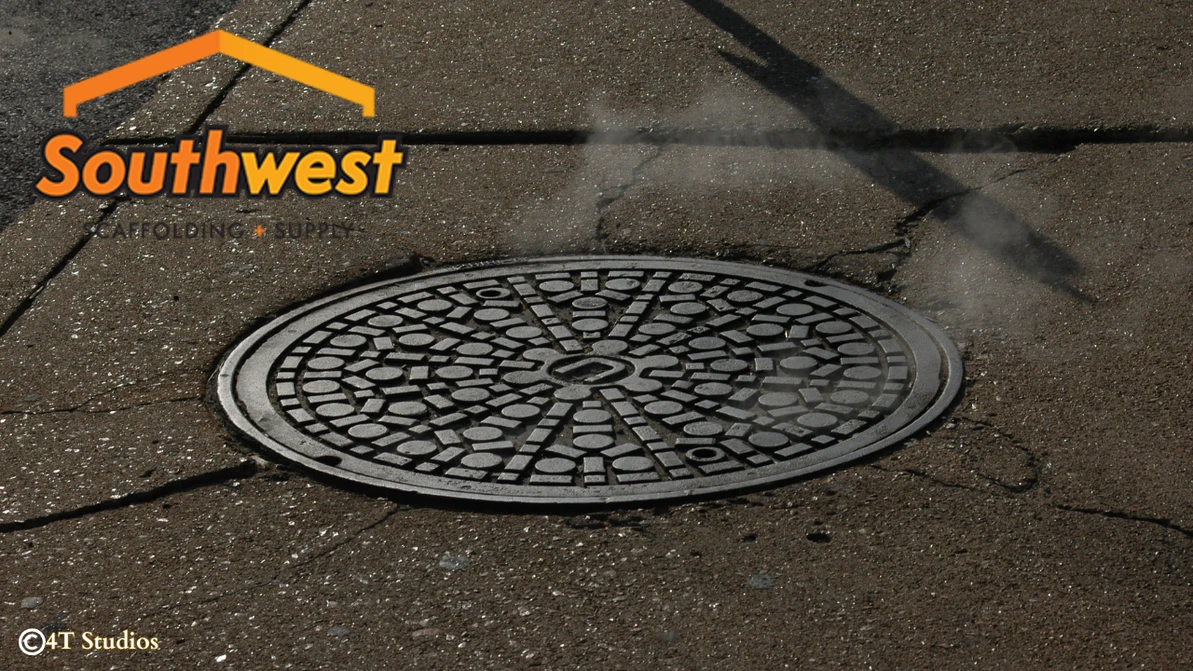
Why Are Manholes Round?
Some construction questions sound almost too simple to ask.
Why are manholes round?
Because they're holes?
Not necessarily.
We make square openings all the time.
Rectangular ones too.
So somewhere along the way, engineers and utility designers had choices.
And yet, all over the world, you keep seeing the same basic thing in streets and sidewalks:
A round hole with a round cover.
Turns out, there's a pretty good reason for that.
Actually, there are several.
And one of them is wonderfully simple:
A round manhole cover can't fall through its own opening.
Welcome back to Why Is It Built Like That?
Today we're looking down.
Way down.
The Cover Can't Fall In
Let's start with the answer everybody knows.
Take a round cover and a slightly smaller round opening.
No matter how you rotate that cover, it can't pass through the hole.
The diameter stays the same.
That's important when you're dealing with a heavy piece of iron sitting above a utility space where people may occasionally need to work.
Now imagine a square opening with a square cover.
Turn that cover diagonally and things get more interesting.
The diagonal distance across a square opening is longer than the width of the cover.
Under the wrong circumstances, a square cover can potentially fit through its opening.
That's not something you particularly want.
Dropping your tape measure down a manhole is annoying.
Dropping the manhole cover down there is a considerably worse afternoon.
Round solves that problem beautifully.
Round Is Easier to Move
Manhole covers are heavy.
They need to be.
They're sitting in streets where cars, trucks, buses, construction equipment, and other loads may travel directly over them.
A flimsy little lid isn't going to work.
Depending on its size and design, a cover can weigh enough that nobody wants to casually pick it up and carry it down the street.
But a round cover has an advantage.
You can roll it.
Once it's lifted from the frame, workers can move it on edge without carrying the entire weight.
That's a pretty nice feature when the thing you're moving is essentially a giant iron plate.
Sometimes good engineering isn't about making something lighter.
It's about making heavy things easier to deal with.
There Isn't a Weak Corner
Corners complicate things.
A round opening distributes forces differently than an opening with sharp corners.
With square or rectangular openings, corners can become locations where stresses concentrate.
Circular shapes avoid those sharp corners.
That's useful when the opening is surrounded by pavement and regularly subjected to vehicle loads.
Think about how much abuse a manhole assembly experiences.
Traffic rolls over it.
Vehicles brake.
Vehicles turn.
The pavement heats and cools.
Water gets into places we'd prefer it didn't.
The surrounding road moves.
Heavy trucks pound across it year after year.
The frame and surrounding structure need to survive all of that while maintaining access to the infrastructure underneath.
Simple shapes can be incredibly effective.
Why Do We Need Such a Big Hole Anyway?
Because people may need to get through it.
The name gives that away.
Manholes provide access to underground systems.
Depending on the location, that may include sewer systems, storm drainage, utilities, telecommunications, electrical infrastructure, or other underground networks.
Workers need a way to inspect, maintain, clean, repair, and access those systems.
A tiny inspection port isn't particularly helpful if somebody needs to get equipment through it or physically enter the space.
So we need an opening large enough to be useful.
Then we need to safely cover it.
And because we're construction people, preferably we'd like the cover to stay where we put it.
A Circle Makes Sense for People Too
Humans aren't square.
Some of us get a little closer with age, but technically we're still not.
A circular opening provides useful clearance for a person climbing through without wasting as much space in corners.
It also works naturally with many underground structures and shafts that are themselves circular.
Circular shafts make structural sense for many applications because loads from surrounding soil can be distributed around the perimeter without the stress concentrations associated with corners.
Once the access shaft is round, putting a round frame and cover on top isn't exactly a shocking design decision.
Not Every Manhole Cover Is Round
Of course, construction refuses to let us make any rule absolute.
There are square and rectangular utility covers.
You'll see them in sidewalks, utility vaults, electrical installations, telecommunications systems, drainage structures, and plenty of other places.
Some access openings need to accommodate equipment rather than just people.
Some systems have different structural requirements.
Some locations aren't exposed to the same traffic loads.
Some covers are designed in sections.
So no, humanity didn't sign an international agreement requiring every underground opening to be circular.
But for traditional street manholes, round solves several problems at once.
That's why it became so common.
Then There's Installation
There's another small advantage to round components.
Orientation doesn't matter nearly as much.
A circular cover doesn't need to be lined up with four specific corners before it drops into its frame.
Rotate it a little.
Rotate it a lot.
It's still round.
Anybody who has spent time installing construction materials knows how valuable that can be.
Especially when the component is heavy.
You don't want to be standing in traffic trying to rotate a 100-plus-pound cover three more inches because somebody missed the corner.
Round is forgiving.
Construction could use more forgiving things.
What Keeps the Cover From Bouncing Around?
You've probably driven over a loose manhole cover.
You know the sound.
CLANK-CLANK.
Something clearly isn't sitting the way it should.
The cover normally rests inside a frame designed to support it and transfer traffic loads into the surrounding structure.
The fit matters.
The condition of the frame matters.
The surrounding pavement matters.
If components wear, settle, loosen, or become damaged, you can get movement, noise, uneven surfaces, and potentially dangerous conditions.
Like everything else in infrastructure, manholes require maintenance.
They just spend most of their lives being driven over, so nobody thinks about them until something goes wrong.
There's an Entire World Under the Street
That's probably the more interesting part of this question.
Most people see a manhole cover and think:
Road.
Construction people see an access point.
Under our streets is an enormous network of infrastructure most people rarely think about.
Water.
Sewer.
Storm systems.
Electric.
Communications.
Gas.
Utility tunnels.
Drainage.
Some of the systems keeping a city functioning are completely invisible until somebody removes one of those covers.
Then suddenly there's a ladder disappearing into another world.
Of course, entering that world is not as simple as popping the cover and climbing down.
Many manholes and underground utility spaces can present confined-space hazards, including dangerous atmospheres, water, traffic exposure, electrical hazards, and other risks.
Access is there for a reason.
So are the safety procedures.
Simple Answers Are Sometimes the Best Ones
The funny thing about manhole covers is that engineers could have designed something far more complicated.
Instead, the circle solves problem after problem.
It can't fall through its own opening.
It can be rolled.
It doesn't have corners that need to be aligned.
The shape works well structurally.
It fits naturally over circular shafts.
And it provides practical access for the people who eventually have to work below.
That's a lot of work being done by one very basic shape.
At Southwest Scaffolding, we're usually helping workers reach things above ground.
Manholes solve the opposite problem.
They get workers below it.
But the principle is the same.
Good access isn't an afterthought.
Somebody has to inspect the structure.
Somebody has to maintain it.
Somebody has to repair it.
And somebody needs a safe way to get there.
So the next time you're sitting at a red light staring at a manhole cover in the pavement, you'll know why it's probably round.
There are several good engineering reasons.
But if you only remember one, make it this:
You really don't want the lid falling down the hole.
Recent Posts
-

Why Are Manholes Round?
Some construction questions sound almost too simple to ask. Why are manholes round? Because they're …Nov 4th 2026 -

Why Do Roads Buckle in Extreme Heat?
It's 100 degrees outside. Your steering wheel is approximately the temperature of the sun. The air c …Oct 29th 2026 -

Why Do Cranes Need Counterweights?
Cranes are impressive machines. They can pick up steel, concrete, equipment, materials, and loads we …Oct 26th 2026