


Construction on Offshore Oil Platforms
Construction on Offshore Oil Platforms
So far in our Scaffolding Around the World series, we've looked at construction in crowded cities, deserts, historic European landmarks, the Arctic, and tropical rainforests.
This time, we're leaving land altogether.
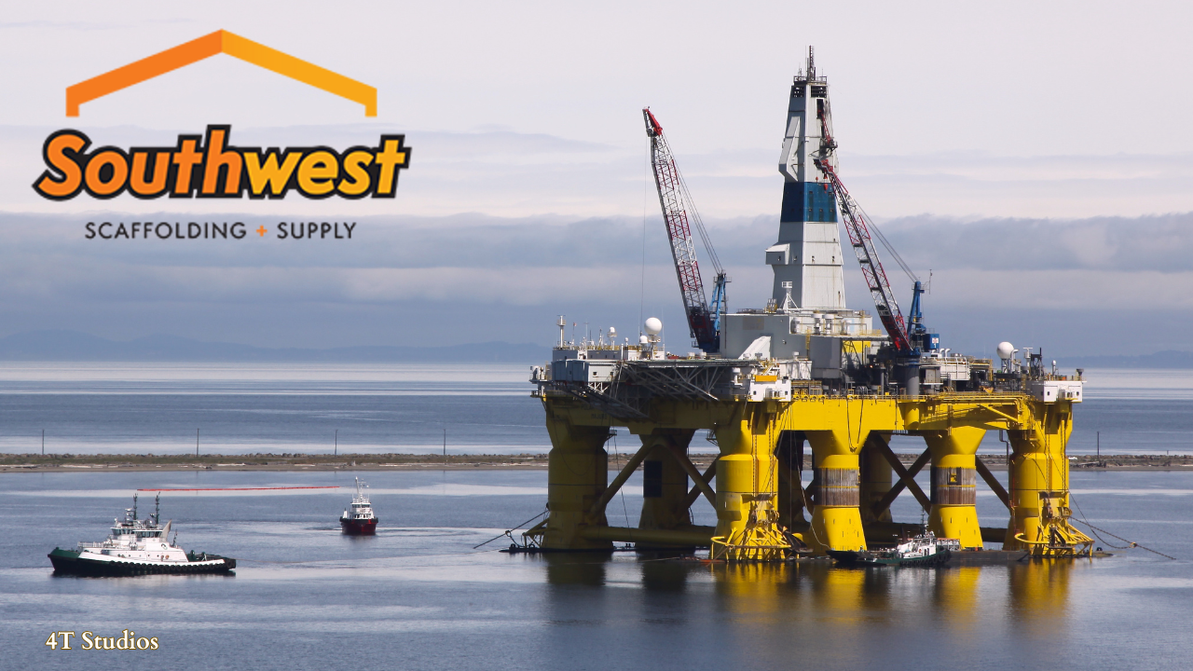
Offshore oil and gas platforms present one of the most unusual construction and maintenance environments in the world.
Workers may be miles from shore, surrounded by water, exposed to wind and salt, and working on structures packed with equipment, piping, machinery, and very little extra space.
There isn't a lumberyard around the corner.
There isn't unlimited room for staging.
And when access is needed on the outside of a structure suspended above the ocean, you can't exactly set your scaffold on the ground.
Welcome to offshore construction.
When There Is No Ground Beneath You
Most scaffolding begins with one basic assumption.
There is something underneath it.
Offshore work can change that equation completely.
Access may be needed around equipment, beneath decks, along structural members, around piping, or on portions of the platform extending over open water.
Traditional supported scaffolding isn't always practical in every location.
That can require specialized access solutions, including suspended scaffolds and tube and clamp systems built around the structure itself.
Every access problem has to be evaluated based on the location, loads, surrounding equipment, and work being performed.
The basic goal hasn't changed.
Workers still need a stable place to work.
Getting that platform where it's needed is the interesting part.
Wind Is Always Part of the Conversation
Anyone who has worked on scaffolding knows wind matters.
Offshore, there may be very little surrounding terrain or structures to provide protection.
Wind can affect workers, materials, lifting operations, and access systems.
It becomes particularly important when scaffold sheeting, netting, or containment systems are added.
Those materials can increase the surface area exposed to wind.
Something intended to contain debris or protect a work area can also change the forces acting on the scaffold — the same effect sheeting has on any scaffold.
That's why wind can't simply be treated as an inconvenience.
It's an engineering consideration.
And conditions can change quickly.
Then There Is the Salt
Saltwater is incredibly hard on construction materials.
Anyone who has lived near the coast has seen what salt air can do to metal.
Now put equipment directly into a marine environment.
Salt, moisture, and oxygen create ideal conditions for corrosion. It's the same chemistry that aged the Statue of Liberty's copper skin.
Steel structures.
Fasteners.
Piping.
Equipment.
Access components.
All require attention.
Corrosion isn't always dramatic.
It develops over time.
A surface that looks acceptable from a distance may be experiencing deterioration that requires closer inspection.
That's why inspection and maintenance are such important parts of offshore work.
The environment never really stops working against the structure.
Maintenance Never Really Ends
An offshore platform isn't simply built and forgotten.
It requires ongoing inspection, maintenance, repair, and modification throughout its service life.
Protective coatings need attention.
Corrosion has to be managed.
Equipment requires servicing.
Piping needs inspection.
Structural components must be monitored.
That means access is needed long after the original construction crews have left.
In many industrial environments, scaffolding isn't simply a construction tool.
It's a maintenance tool, and the accessories that go with it matter as much as the scaffold itself.
And on an offshore platform, reliable access can be essential to keeping critical systems operating.
Space Is Valuable
One thing offshore platforms don't have much of is extra room.
Every area serves a purpose.
Equipment.
Piping.
Walkways.
Storage.
Workspaces.
Safety systems.
Living quarters on some installations.
Trying to fit temporary access into an already crowded environment requires careful planning.
Scaffolding can't unnecessarily interfere with operations.
Workers still need escape routes and access to equipment.
Other crews still need to perform their jobs.
A scaffold that solves one access problem can't be allowed to create three more.
That makes coordination incredibly important.
Getting Materials Offshore
On a typical construction project, forgetting a component might mean a quick trip to the supplier.
Offshore, logistics are a little different.
Workers, equipment, materials, food, tools, and replacement parts all have to reach the platform.
Depending on the location and operation, transportation may involve vessels or helicopters.
Everything sent offshore takes planning.
Space and weight matter.
Timing matters.
Weather matters.
A missing component can create much more than an inconvenience when the nearest supplier is back on shore.
Once again, good planning becomes one of the most valuable tools on the project.
The Human Side of Offshore Work
Offshore work isn't only demanding on equipment.
It's demanding on people.
Workers may spend extended periods away from home.
Shifts can be long.
Weather conditions can be challenging.
Work areas can be noisy, crowded, and exposed.
Fatigue and communication become important safety considerations.
Emergency planning also takes on an entirely different meaning when you're miles from shore.
On land, help may be minutes away.
Offshore, crews need to be prepared for situations where outside assistance may take longer to arrive.
That makes training and preparation especially important.
Safety Has to Be Built Into Everything
Offshore environments bring multiple hazards together in one location.
Water.
Weather.
Heavy equipment.
Industrial processes.
Confined areas.
Corrosion.
Limited access.
That means safety can't simply be something discussed before work begins.
It has to be part of how the entire operation functions.
Access systems need to support that environment rather than complicate it.
Good scaffolding isn't simply about reaching the work.
It's about reaching it safely while allowing everyone else to continue doing their jobs.
Construction Without Borders
Technically, an offshore platform isn't our next country in Scaffolding Around the World.
But it may be one of the best examples of why we're doing this series.
Construction changes depending on where the work takes place.
Sometimes the challenge is extreme cold.
Sometimes it's heat.
Sometimes it's a crowded city.
And sometimes it's the fact that your jobsite is standing in the middle of the ocean.
At Southwest Scaffolding, we know access problems don't always happen in convenient places. The more difficult the environment becomes, the more important planning, inspection, communication, and the right access solution become.
Because construction doesn't stop at the shoreline.
Sometimes that's where the interesting part begins.
Recent Posts
-

Why Do Cranes Need Counterweights?
Cranes are impressive machines. They can pick up steel, concrete, equipment, materials, and loads we …Oct 26th 2026 -

Why Are Cooling Towers Shaped Like That?
Some structures are instantly recognizable. You can see a massive cooling tower from miles away. Wid …Oct 21st 2026 -
Why Are Water Towers So High?
Every small town seems to have one. A giant tank sitting way up in the air with the town's name pain …Oct 19th 2026