

Scaffolding Sagrada Família
Scaffolding Sagrada Família
Most contractors hope their projects don't run behind schedule.
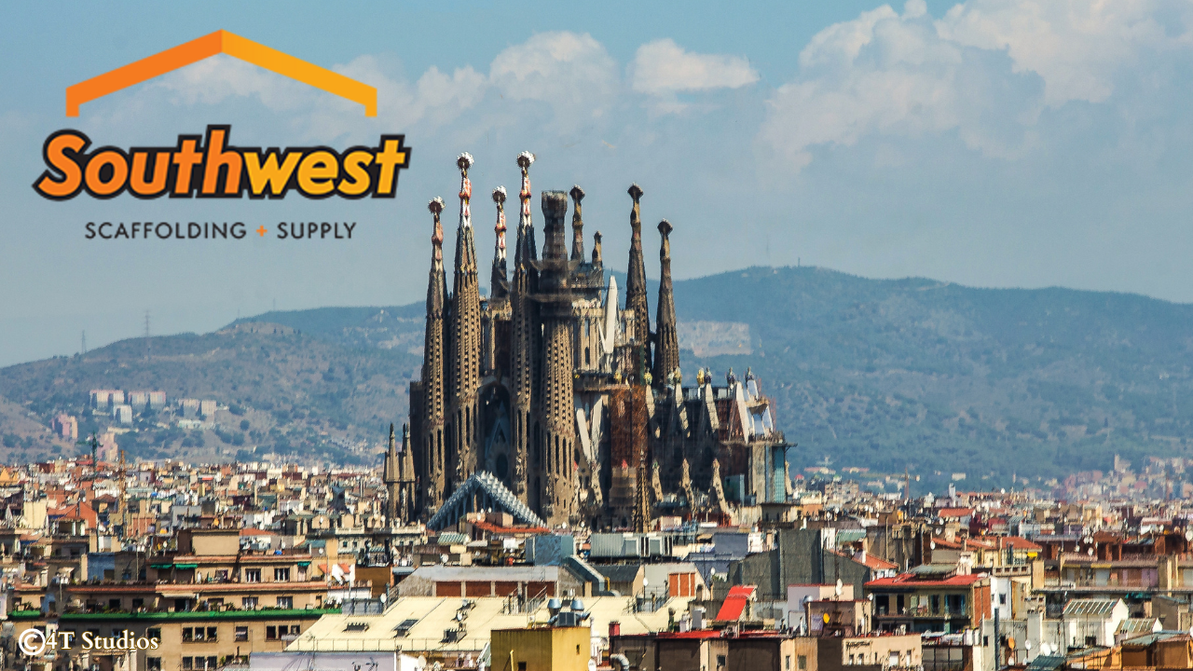
Then there's Sagrada Família.
Construction on Barcelona's famous basilica began in 1882.
More than 140 years later, workers are still building it.
Generations of architects, engineers, stoneworkers, sculptors, craftsmen, and construction crews have worked on the structure. Technology has changed dramatically. Construction methods have changed. Equipment has changed.
The building has continued.
That makes Sagrada Família one of the most unusual construction projects in the world.
Unlike Notre-Dame, where scaffolding helps preserve a cathedral completed centuries ago, scaffolding and temporary access at Sagrada Família have helped generations of workers continue building something the original craftsmen never lived to see finished.
Welcome back to Scaffolding Around the World.
This time, we're heading to Barcelona.
A Construction Project Spanning Generations
Sagrada Família was never intended to be a quick project.
When architect Antoni Gaudí took over the design in the 1880s, he knew he probably wouldn't live to see it completed.
He was right.
Gaudí died in 1926, when only a portion of the basilica had been built.
Other architects and craftsmen continued the work.
Then came war.
Funding challenges.
Design questions.
Changing construction technology.
And the simple reality that Sagrada Família is incredibly complicated.
Most construction projects change project managers.
This one has changed generations.
Nothing About the Building Is Simple
If scaffolders like straight walls and predictable elevations, Sagrada Família is not going to make their day easy.
Look at the building.
Towers rise at different heights.
Stone surfaces curve.
Sculptures project outward.
Openings change shape.
Decorative elements cover enormous portions of the structure.
Columns branch like trees.
The geometry seems to change everywhere you look.
This isn't a building where you simply run scaffold along a flat elevation and call it a day.
Access has to adapt to the architecture.
And Gaudí wasn't exactly known for boring architecture.
When the Building Keeps Getting Taller
Sagrada Família's towers are among its defining features.
As construction progresses upward, access becomes increasingly complicated.
Workers need to reach areas hundreds of feet above the streets of Barcelona.
Materials have to reach them too.
Stone.
Tools.
Structural components.
Decorative pieces.
Equipment.
Everything required to build at ground level eventually has to find its way upward.
That requires cranes, platforms, temporary access systems, and careful coordination between trades.
At those heights, even a relatively simple task can become a logistical operation.
Modern Technology Changed the Project
Here's where Sagrada Família becomes especially interesting.
The earliest workers built using traditional methods.
Stone was shaped by skilled craftsmen.
Measurements were made without computers.
Complex forms had to be developed physically.
Today's crews have tools Gaudí could never have imagined.
Computer modeling allows designers to study complicated geometry.
Digital fabrication helps create components with remarkable precision.
CNC machinery can assist with shaping stone.
Modern cranes lift materials high above the city.
Engineered access systems allow workers to reach increasingly complex areas.
Technology hasn't replaced craftsmanship.
It has given craftsmen new tools.
Gaudí Left a Complicated Puzzle
Continuing someone else's construction project is difficult.
Continuing it more than a century after the original architect died is something else entirely.
Gaudí left models, drawings, photographs, and design concepts that later generations have studied while continuing the basilica.
Some original materials were damaged or destroyed during the Spanish Civil War, adding another layer of difficulty.
Later architects have had to interpret Gaudí's vision while also solving engineering and construction problems he never had the technology to address.
It's part architecture.
Part engineering.
Part history.
And occasionally part detective work.
Scaffolding Becomes Part of the Landscape
Most construction scaffolding is temporary enough that people barely remember it.
Sagrada Família is different.
For generations of Barcelona residents, construction equipment, cranes, temporary platforms, and scaffolding have simply been part of the building.
People have grown up watching it change.
Children who saw construction underway became adults.
Then grandparents.
Meanwhile, another tower rose.
Another façade progressed.
Another generation of workers arrived.
There aren't many construction projects where temporary access can become part of a city's collective memory.
Working Around Millions of Visitors
Here's another complication.
Sagrada Família isn't a closed construction site.
It's also one of Barcelona's biggest attractions.
Millions of people want to see it.
That means construction and tourism have to coexist.
Workers need access.
Visitors need access.
Materials need to move.
Work zones have to remain controlled.
Public areas need protection.
Deliveries need coordination.
All while construction continues on an internationally recognized landmark.
It's one thing to build a complicated structure.
It's another to build it while people from around the world are showing up every day to look at it.
The Building Is Both Old and New
This may be the strangest thing about Sagrada Família.
It's historic.
And it's still under construction.
Some portions have been standing for more than a century.
Other portions are comparatively new.
That means teams may deal with preservation and new construction on the same building.
Older stone requires maintenance.
Existing areas need inspection.
New components continue being installed.
Sagrada Família isn't simply moving from construction to maintenance.
In some areas, those phases overlap.
Few projects demonstrate the full life cycle of a building quite like this one.
What Does "Finished" Even Mean?
For decades, people have asked when Sagrada Família will finally be finished.
Various completion targets have shifted over the years, including after the COVID-19 pandemic disrupted construction and visitor revenue.
Major milestones continue to be reached, but portions of the overall project and surrounding work remain ongoing.
After more than 140 years, perhaps the more interesting story isn't the final completion date.
It's everything that happened along the way.
Construction methods evolved.
Engineering evolved.
Safety evolved.
Access systems evolved.
Yet workers continued pursuing the same basic vision.
The Workers Become Part of the Story
Most construction workers will never know who built a cathedral 500 years later.
Their names may disappear.
Their work doesn't.
Sagrada Família makes that reality unusually visible.
Multiple generations of craftspeople have contributed to one structure.
Some worked on foundations.
Others on façades.
Others on towers.
Today's workers are continuing something begun before their great-grandparents were born.
Future workers may maintain portions built today.
That's a powerful reminder of what construction really is.
We don't always build only for ourselves.
Sometimes we're continuing the work of people who came before us for people who haven't arrived yet.
A Scaffold Between Generations
At Southwest Scaffolding, we usually think of scaffolding as temporary.
It goes up.
Workers use it.
The work gets completed.
The scaffold comes down.
Sagrada Família turns that idea on its head.
The individual scaffolds are still temporary, but the need for construction access has continued across generations.
Different workers.
Different equipment.
Different technology.
Same building.
And perhaps that's what makes Sagrada Família such a perfect addition to Scaffolding Around the World.
Notre-Dame showed us how temporary access can help save something generations before us completed.
Sagrada Família shows us how temporary access can help one generation continue what another generation started.
Because sometimes construction isn't about finishing the job you began.
Sometimes it's about doing your part well enough for the next generation to keep building.
Recent Posts
-

Why Are Cooling Towers Shaped Like That?
Some structures are instantly recognizable. You can see a massive cooling tower from miles away. Wid …Oct 21st 2026 -
Why Are Water Towers So High?
Every small town seems to have one. A giant tank sitting way up in the air with the town's name pain …Oct 19th 2026 -
Why Do Masonry Walls Need to Breathe?
Let's get one thing out of the way first. Your brick wall isn't actually breathing. It doesn't inhal …Oct 16th 2026