



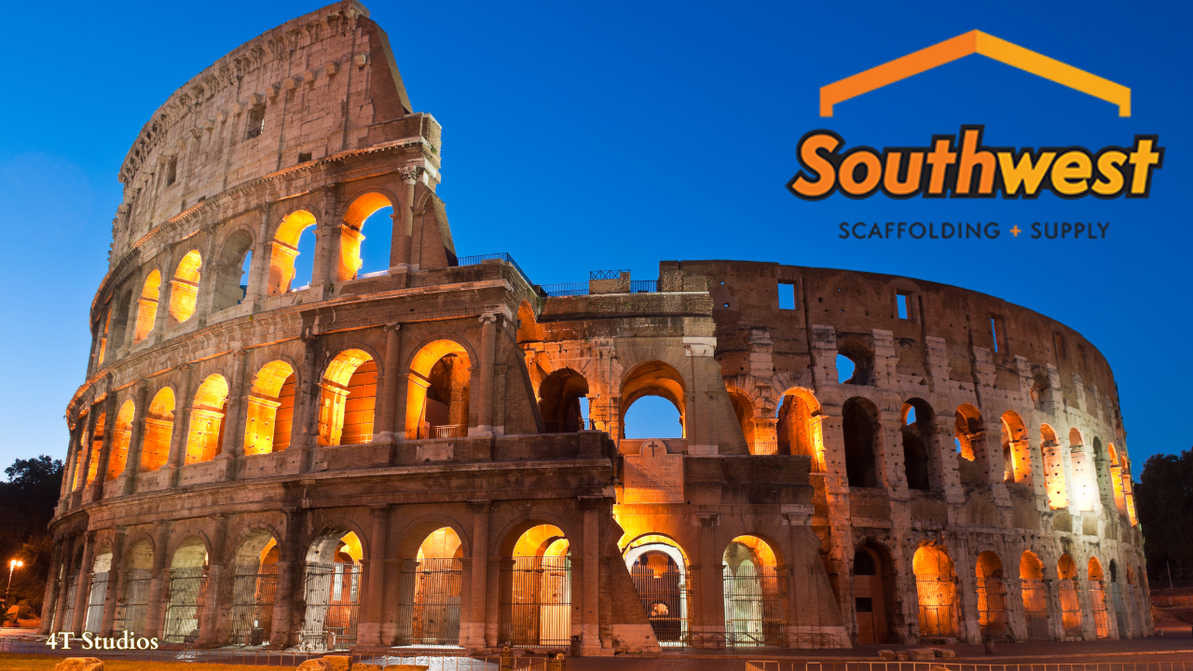
Scaffolding the Colosseum
Scaffolding the Colosseum
Some restoration projects involve buildings that are 50 years old.
Some involve buildings that are 200 years old.
And then there's the Colosseum.
Construction on Rome's famous amphitheater began nearly 2,000 years ago.
Since then, it has survived earthquakes, fires, weather, pollution, stone removal, changing uses, and more generations of visitors than its original builders could possibly have imagined.
And it's still standing.
Not untouched.
Not complete.
But standing.
Keeping it that way requires something the Roman builders certainly didn't have in mind when they constructed it:
Modern conservation.
And before preservation specialists can repair ancient stone, stabilize masonry, inspect arches, or clean centuries of buildup, they first have to reach it.
Welcome back to Scaffolding Around the World.
This time, we're scaffolding the Colosseum.
A Building Made of Arches
At first glance, the Colosseum may seem like a relatively straightforward structure to scaffold.
It's basically a giant oval.
Then you get closer.
Arches.
Columns.
Openings.
Curved walls.
Multiple levels.
Irregular surfaces.
Ancient stone.
Areas that have been repaired repeatedly over centuries.
Suddenly that simple oval becomes a very complicated three-dimensional access problem.
Scaffolding can't simply run along a flat façade.
It has to adapt to the geometry of the structure while giving conservators access to individual stones, joints, arches, decorative elements, and structural areas.
That's where access becomes part of the restoration strategy itself.
The Romans Knew Masonry
The Colosseum wasn't built from one material.
Roman builders used a combination of materials and construction methods, including travertine stone, brick, concrete, and other masonry materials.
Different portions of the structure performed different jobs.
Some carried enormous loads.
Others created walls, vaults, passageways, and seating areas.
That complexity is one reason preservation isn't as simple as replacing whatever looks damaged.
You have to understand what you're looking at.
What material is it?
What function did it serve?
Is the deterioration active?
Is the problem caused by water?
Movement?
Previous repairs?
Pollution?
Age?
Good restoration starts with diagnosis.
That was true in ancient Rome.
It's still true today.
Two Thousand Years Leave a Mark
Masonry can last an incredibly long time.
The Colosseum proves it.
But even masonry has enemies.
Water enters cracks and joints.
Temperature changes create movement.
Earthquakes place stress on the structure.
Pollution affects exposed surfaces.
Vegetation finds opportunities to grow.
Mortar deteriorates.
Metal components corrode.
And sometimes humans create more damage than nature ever could.
Over the centuries, stone from the Colosseum was removed and reused elsewhere in Rome.
The structure we see today is only part of what originally existed.
Preservation teams aren't trying to make the Colosseum new again.
They're trying to protect what survived.
Cleaning Isn't as Simple as It Sounds
Historic masonry cleaning requires restraint.
Anyone with enough pressure can make an old surface look different.
That doesn't mean they've improved it.
Ancient stone can contain weathered surfaces, historic deposits, previous repairs, and fragile areas.
Aggressive cleaning can remove more than dirt.
It can remove material that can never be replaced.
That's why conservation work requires testing, documentation, and an understanding of the substrate.
The goal isn't necessarily to make a 2,000-year-old building look brand new.
It should look 2,000 years old.
The goal is to help it survive another generation.
Modern Materials Aren't Automatically Better
This is one of the most important lessons in historic masonry.
Newer doesn't always mean more appropriate.
Modern repair materials can behave very differently from historic materials.
Strength matters.
Permeability matters.
Movement matters.
Compatibility matters.
A repair that is too rigid or too impermeable can sometimes transfer stress or trap moisture in surrounding historic masonry.
That means restoration specialists have to think beyond the repair itself.
The question isn't simply:
"Will this material hold?"
It's:
"How will this material interact with everything around it?"
That's a lesson that applies to historic masonry everywhere, not just Rome.
Where Do You Attach the Scaffold?
Modern buildings often provide relatively predictable conditions for scaffold ties and access planning.
The Colosseum is not a modern building.
Drilling indiscriminately into ancient masonry isn't exactly an acceptable solution.
Historic surfaces have to be protected.
Existing conditions have to be understood.
Loads have to be carefully managed.
Contact points matter.
Anchoring decisions matter.
Temporary access can't create permanent damage.
That's one of the fascinating contradictions of restoration scaffolding.
The scaffold has to be strong enough to support the work while being gentle enough to protect the structure.
Working Around Millions of Visitors
Then there are the people.
The Colosseum isn't sitting abandoned in a field.
It's one of the most visited historic sites in the world.
Restoration work has to exist alongside tourism, archaeology, preservation, and the daily life of Rome.
That means controlling work areas.
Protecting the public.
Managing tools and materials.
Coordinating access.
Limiting unnecessary disruption.
Sometimes construction isn't difficult because the work itself is unusual.
It's difficult because the world doesn't stop while you do it.
Archaeology Is Everywhere
On many jobsites, finding an old wall underground is an inconvenience.
At the Colosseum, it's archaeology.
Every portion of the site has historical value.
That means contractors and preservation teams have to work differently.
You don't simply remove something because it's in the way.
You document it.
Study it.
Protect it.
And sometimes change the entire plan because of it.
History gets a seat at the project meeting.
Ancient Craftsmanship Meets Modern Technology
Today's preservation teams have tools Roman builders could never have imagined.
Laser scanning.
Digital modeling.
Structural monitoring.
Advanced surveying.
High-resolution photography.
Material analysis.
These technologies allow specialists to document deterioration and understand the structure in remarkable detail.
But eventually, technology reaches its limit.
Someone still has to stand next to the wall.
Someone has to inspect the stone.
Someone has to repair the joint.
Someone has to perform the conservation work.
And that person needs safe access.
Temporary Scaffolding, Ancient History
There's something almost funny about surrounding a 2,000-year-old structure with something designed to exist for only a few months or years.
But that's exactly what makes scaffolding so important to historic preservation.
It's temporary by design.
The work performed from it isn't.
At Southwest Scaffolding, we understand that access is often the first step in repairing, maintaining, or preserving a structure.
Sometimes that structure is a modern commercial building.
Sometimes it's an industrial facility.
And sometimes it's an ancient amphitheater that has already survived nearly two thousand years.
Because when a building has been standing since the Roman Empire, the goal isn't to make it look new.
It's to make sure it's still standing when the next generation comes to see it.
Recent Posts
-
Why Do Masonry Walls Need to Breathe?
Let's get one thing out of the way first. Your brick wall isn't actually breathing. It doesn't inhal …Oct 16th 2026 -
Why Are Buildings Built on Piles?
Most buildings look like they're sitting on the ground. Sometimes that's a little misleading. The bu …Oct 13th 2026 -
Why Are There Gaps in Concrete?
Concrete cracks. There. We said it. Not exactly the opening line the concrete industry would put on …Oct 12th 2026