



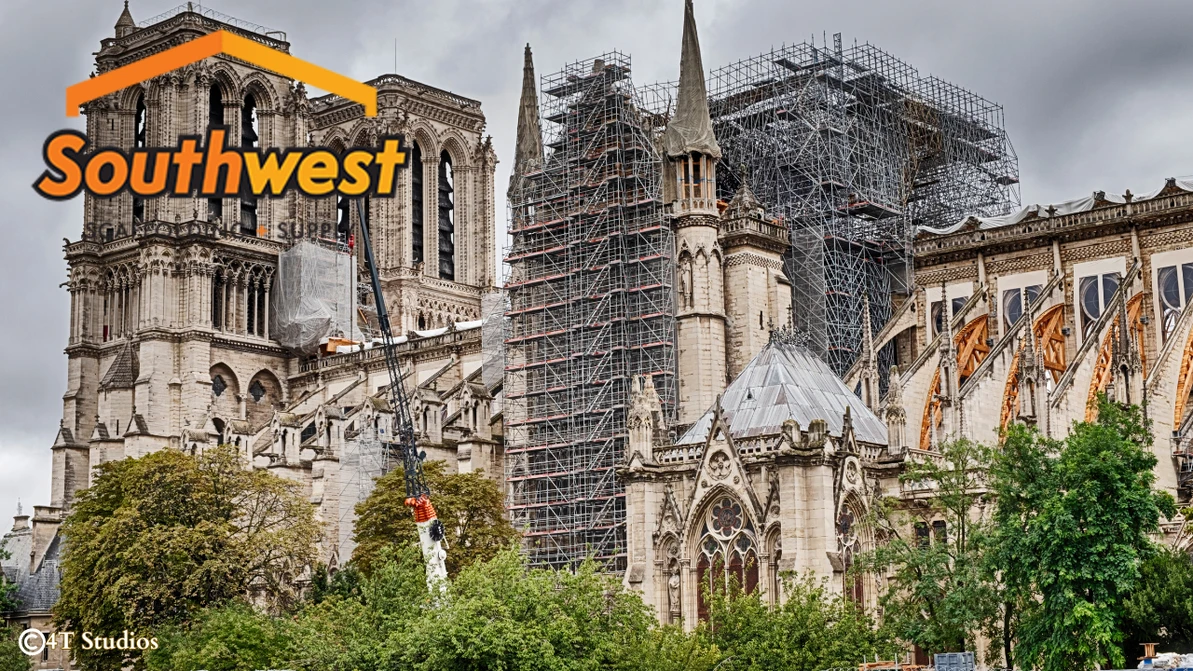
Scaffolding Notre-Dame
Scaffolding Notre-Dame
On April 15, 2019, people around the world watched as flames engulfed Notre-Dame Cathedral in Paris.
The roof burned.
The famous spire collapsed.
Centuries-old timber framing was destroyed.
Stone vaults were damaged.
And firefighters fought desperately to save one of the world's most recognizable historic buildings.
But there was another complication already surrounding the cathedral.
Scaffolding.
Before the fire began, Notre-Dame was already undergoing restoration. Hundreds of tons of scaffolding had been erected around the spire.
When the fire tore through the roof and spire, intense heat twisted and fused portions of that scaffold into a tangled mass of metal high above the cathedral.
Before restoration could truly move forward, workers faced an extraordinary problem.
They first had to safely remove the scaffold that had originally been installed to help restore the building.
Welcome back to Scaffolding Around the World.
This time, we're heading to Notre-Dame.
A Restoration Project Before the Fire
It's easy to forget that Notre-Dame was already a construction site when the fire occurred.
The cathedral had been standing for more than 800 years and needed extensive maintenance.
Stone deteriorates.
Mortar fails.
Water finds openings.
Pollution affects surfaces.
Historic structures require constant attention.
Scaffolding had been erected around the spire to give restoration crews access to the upper portions of the cathedral.
Then everything changed.
What had been a normal historic restoration project became one of the most closely watched preservation efforts in the world.
The Scaffold Survived, Sort Of
When the spire collapsed, the surrounding scaffold didn't simply fall neatly to the ground.
Sections remained standing.
But the heat had badly distorted the metal.
Components twisted.
Connections changed.
Pieces fused together.
The remaining structure became unstable and unpredictable.
Imagine dismantling scaffolding when you can no longer assume the scaffold behaves like scaffolding.
Workers couldn't simply begin taking components apart in the normal sequence.
The damaged structure had to be carefully studied, stabilized, and removed.
The temporary access system had become a hazard of its own.
How Do You Remove Something You Can't Safely Stand On?
This created one of the most unusual scaffold dismantling problems imaginable.
Normally, workers dismantling scaffolding use the structure itself for access.
But portions of the Notre-Dame scaffold had been damaged by extreme heat.
That meant crews needed other ways to reach it.
Specialized access methods were used while workers carefully cut apart damaged sections.
Piece by piece, the tangled metal surrounding the cathedral was removed.
It was slow.
It was complicated.
And it had to be done without causing additional damage to the fragile structure beneath it.
Before scaffolding could help rebuild Notre-Dame, workers first had to remove the scaffolding left behind by the disaster.
The Cathedral Needed Support Too
The fire damaged more than the roof.
The loss of the timber structure and portions of the vaulting changed how loads moved through the building.
Historic masonry that had stood for centuries suddenly existed under different conditions.
Temporary stabilization became critical.
Engineers had to evaluate walls, vaults, flying buttresses, gables, and other structural elements.
Some areas required temporary supports while restoration teams assessed their condition.
This is one of the realities of disaster recovery.
Before you rebuild anything, you have to make sure what remains is stable enough to work around.
Then Came the Access Problem
Once the damaged pre-fire scaffold was removed and the structure stabilized, the restoration still required enormous amounts of access.
Stone masons.
Carpenters.
Roofers.
Metalworkers.
Conservators.
Painters.
Engineers.
Inspectors.
All needed to reach different portions of the cathedral.
New scaffolding and temporary working platforms became essential throughout the restoration.
The same type of temporary structure that had created such an unusual challenge after the fire once again became one of the tools helping save the cathedral.
Medieval Construction Meets Modern Access
Notre-Dame began construction in the 12th century.
Its original builders didn't have tower cranes, powered lifts, computer models, laser scanning, or modern engineered scaffold systems.
Yet they created a building that survived more than eight centuries.
Today's restoration teams have access to technology those builders could never have imagined.
Digital modeling.
Laser scanning.
Structural monitoring.
Modern lifting equipment.
Engineered scaffolding.
But eventually, someone still has to stand next to the stone.
Someone has to repair the mortar.
Someone has to set the timber.
Someone has to install the roofing.
Someone has to inspect the detail.
Technology can tell you where the problem is.
Skilled tradespeople still have to reach it.
Rebuilding the Spire
One of the most symbolic parts of the restoration was rebuilding the cathedral's spire.
The spire destroyed in the fire wasn't actually medieval. It had been designed by architect Eugène Viollet-le-Duc during the 19th century.
The decision was made to reconstruct it according to that historic design.
That required an extraordinary combination of traditional craftsmanship and modern construction.
Timber framing.
Lead roofing.
Decorative elements.
Structural work.
And extensive temporary access.
For a period of time, the cathedral once again disappeared behind scaffolding as workers reconstructed what the world had watched collapse.
Restoration Isn't About Making Something New
One of the most fascinating parts of Notre-Dame's restoration is the philosophy behind it.
The goal wasn't to build a modern cathedral inside an old shell.
It was to preserve Notre-Dame.
Traditional materials and techniques played an important role.
Craftspeople recreated timber framing.
Stone was repaired.
Historic surfaces were conserved.
Decorative elements were restored.
Modern engineering helped make the work possible, but the objective remained preservation.
That's the heart of good historic restoration.
Use today's knowledge to protect yesterday's craftsmanship.
Five Years Later
Notre-Dame reopened in December 2024, just over five years after the fire.
For the millions of people who followed the restoration, the reopening represented something remarkable.
A building that many feared might be lost had survived.
But behind that reopening were thousands of workers and craftspeople solving one difficult problem after another.
And throughout much of that process, temporary access systems allowed them to reach places few people will ever see up close.
Temporary Structures Saving Permanent History
The story of Notre-Dame may be one of the most unusual scaffolding stories in modern construction.
Scaffolding was there before the fire.
The fire transformed it into a dangerous obstacle.
Workers painstakingly removed it.
Then new access systems returned to help restore the cathedral.
It's hard to find a better example of how important temporary structures can become during preservation work.
At Southwest Scaffolding, we know scaffolding isn't the finished project.
It's the structure that helps other skilled trades perform theirs.
Most of the time, it disappears without anyone thinking much about it.
But sometimes, as Notre-Dame showed the world, the scaffolding becomes part of the story itself.
Because before history can be restored, someone has to find a safe way to reach it.
Recent Posts
-

Why Do Cranes Need Counterweights?
Cranes are impressive machines. They can pick up steel, concrete, equipment, materials, and loads we …Oct 26th 2026 -

Why Are Cooling Towers Shaped Like That?
Some structures are instantly recognizable. You can see a massive cooling tower from miles away. Wid …Oct 21st 2026 -
Why Are Water Towers So High?
Every small town seems to have one. A giant tank sitting way up in the air with the town's name pain …Oct 19th 2026