


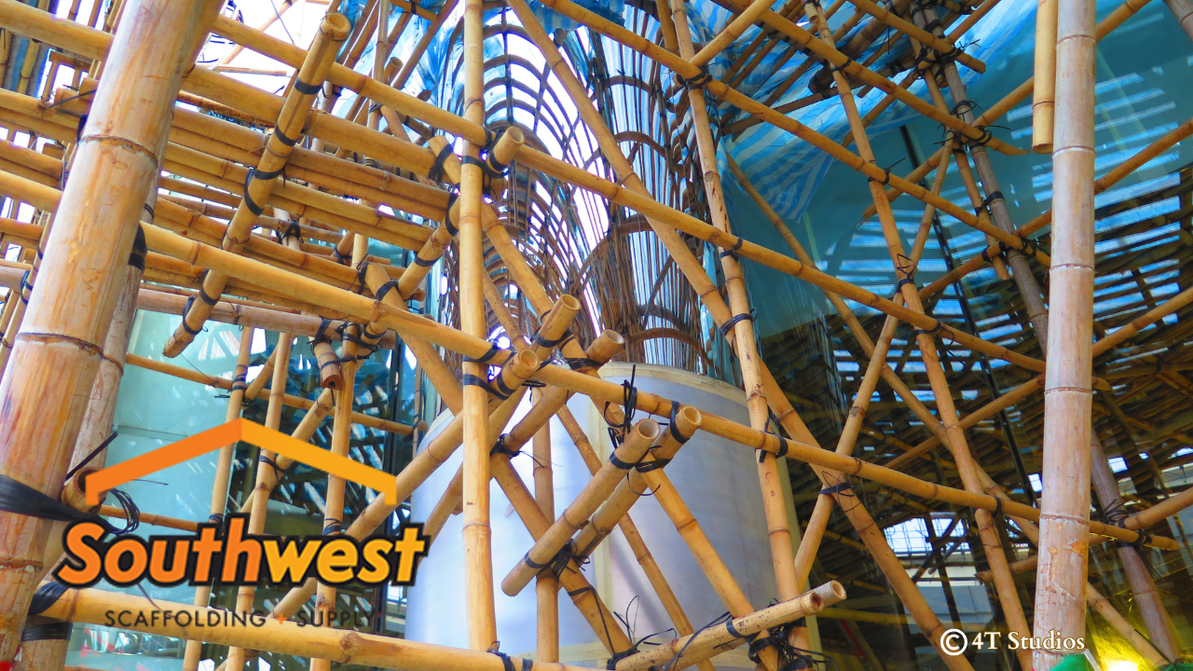
Bamboo Scaffolding in Hong Kong
Bamboo Scaffolding in Hong Kong: An Ancient Method Still Reaching New Heights
When most people picture scaffolding, they imagine steel frames, aluminum components, guardrails, and engineered systems designed to support workers high above the ground.
So imagine the surprise many people experience when they learn that some construction crews in Hong Kong still use bamboo scaffolding on projects that reach dozens of stories into the air.
At first glance, it sounds impossible.
Bamboo?
For skyscrapers?
Yet for generations, bamboo scaffolding has been a common sight throughout Hong Kong, and even today it remains one of the most fascinating examples of how construction methods can vary around the world.
While modern steel systems are becoming increasingly common, bamboo scaffolding continues to play an important role in many projects, particularly building maintenance, repairs, renovations, and exterior access work.
It's a reminder that sometimes the oldest building methods continue to survive because they work.
Why Bamboo?
For people unfamiliar with bamboo, it can seem like an unusual choice for construction access.
The reality is that bamboo possesses several characteristics that make it remarkably useful.
It is lightweight.
It is flexible.
It has an impressive strength-to-weight ratio.
It can be transported and assembled quickly.
Workers can move large quantities of bamboo with far less effort than many traditional scaffold components.
In densely populated urban areas like Hong Kong, where buildings are packed closely together and space is limited, those advantages can be significant.
The material is also readily available throughout much of Asia, making it both practical and economical.
A Tradition Passed Through Generations
Bamboo scaffolding isn't something workers learn overnight.
Traditionally, the skills required to design and erect bamboo structures have been passed from one generation to the next.
Experienced scaffolders teach newer workers how to select materials, tie connections, distribute loads, and construct safe access systems.
In Hong Kong, professional training programs now help preserve and formalize many of these skills.
The work requires precision, experience, and a deep understanding of how the material behaves.
While outsiders sometimes view bamboo scaffolding as primitive, the reality is quite the opposite.
Building safe bamboo scaffolding requires specialized knowledge and training.
The Secret Is in the Connections
One reason bamboo scaffolding works so well is the way the components are connected.
Rather than relying primarily on metal couplers and connectors, workers traditionally use specially designed nylon ties to secure bamboo poles together. Steel systems in the West take the opposite approach — tube and clamp scaffold is rigid by design, with every joint clamped tight.
These connections create a structure that is surprisingly adaptable.
Instead of resisting every movement rigidly, bamboo scaffolding can flex slightly under certain conditions.
This flexibility can actually help distribute loads and reduce stress concentrations throughout the structure.
Of course, proper assembly remains critical.
Like any scaffold system, the safety of the structure depends on the quality of its design, installation, and maintenance.
Working Among the Skyscrapers
Hong Kong's skyline is one of the most recognizable in the world.
Towering residential buildings, commercial high-rises, and dense urban development create unique construction challenges.
Many of these structures require ongoing maintenance, façade repairs, window replacement, painting, and restoration work.
Bamboo scaffolding has long provided access for these projects.
To visitors, seeing bamboo structures climbing the sides of tall buildings can be startling.
To local contractors, it's simply part of the landscape.
For decades, workers have used bamboo scaffolding to reach places that would otherwise be difficult and expensive to access. It's a similar story in Japan, where dense cities and tight sites shape nearly every access decision.
Safety Has Evolved
One common misconception is that bamboo scaffolding operates without safety standards.
In reality, Hong Kong has developed regulations, training requirements, and safety guidelines governing its use.
Workers receive training.
Inspections are performed.
Safety procedures are followed.
Like any construction system, accidents can occur when standards are ignored.
The material itself is only part of the equation.
Safe outcomes depend on proper design, competent workers, and consistent attention to safety practices.
The same principles apply whether the scaffold is made from bamboo, steel, or aluminum.
What Can We Learn From It?
One of the most interesting aspects of construction is that there is rarely only one way to solve a problem.
Different countries often develop solutions based on available materials, local traditions, environmental conditions, and economic realities.
Bamboo scaffolding is a perfect example.
While most contractors in the United States would never consider bamboo as a primary scaffold material, it has served workers successfully in Hong Kong for generations.
That doesn't mean one system is universally better than another.
It means construction solutions often evolve to meet the needs of a particular place and time.
A Global Industry
One of the goals of our Scaffolding Around the World series is to explore how contractors across the globe approach access, safety, and construction challenges.
The materials may change.
The methods may change.
The regulations may change.
But the objective remains the same.
Workers need safe, reliable access to perform their jobs.
Whether it's bamboo in Hong Kong, engineered systems in North America, or specialized access solutions in Europe, scaffolding continues to be one of the most important tools in construction.
At Southwest Scaffolding, we appreciate the innovation and craftsmanship found throughout the industry. Looking at how different countries approach scaffolding reminds us that construction is both a science and a craft, shaped by local knowledge, experience, and ingenuity.
Because sometimes the most fascinating solutions are the ones that have been standing for generations.
Recent Posts
-
Why Do Masonry Walls Need to Breathe?
Let's get one thing out of the way first. Your brick wall isn't actually breathing. It doesn't inhal …Oct 16th 2026 -

Why Are Buildings Built on Piles?
Most buildings look like they're sitting on the ground. Sometimes that's a little misleading. The bu …Oct 13th 2026 -
Why Are There Gaps in Concrete?
Concrete cracks. There. We said it. Not exactly the opening line the concrete industry would put on …Oct 12th 2026