



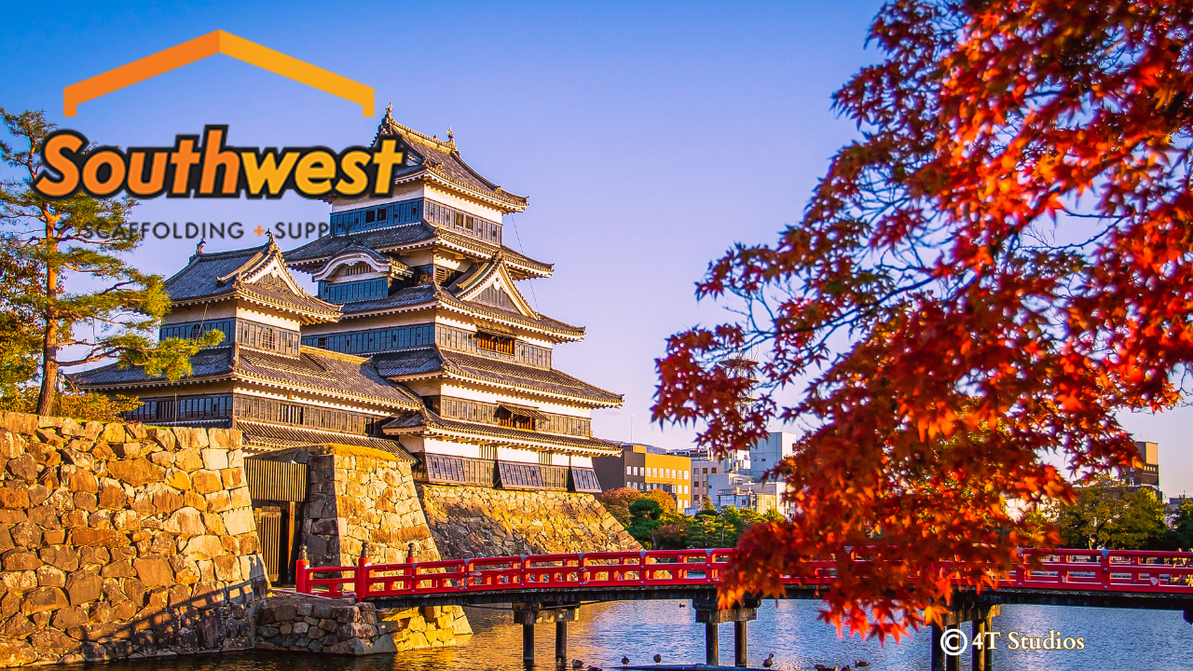
Scaffolding In Japan
Scaffolding in Japan
Japan is a country where ancient temples can stand only a short distance from modern skyscrapers.
It's also a country where construction has to deal with challenges that many contractors will never encounter.
Dense cities.
Limited space.
Earthquakes.
Typhoons.
Aging buildings.
And some of the highest expectations for organization and precision in the world.
All of this makes scaffolding in Japan an interesting stop in our Scaffolding Around the World series.
Because when space is tight, environmental conditions can change quickly, and structures must be built to withstand seismic activity, access can't be an afterthought.
It has to be part of the plan.
Building Where Space Is Limited
One of the first things you notice in cities like Tokyo and Osaka is density.
Buildings sit close together.
Streets can be narrow.
Pedestrians, bicycles, vehicles, businesses, and construction activity may all be competing for the same limited space.
On a wide-open construction site, contractors may have plenty of room to stage materials and equipment.
In a dense Japanese city, every foot can matter.
That creates an interesting challenge for scaffolding.
Workers still need safe access, but the scaffold also has to fit within the realities of the surrounding environment.
Sometimes the real engineering challenge isn't how high you need to go.
It's how little room you have to get there. In tight urban work, the right scaffolding setup is often the difference between a workable job and a stalled one.
Earthquakes Change the Conversation
You can't talk about construction in Japan without talking about earthquakes.
Japan is one of the most seismically active countries in the world, and that reality has influenced generations of building practices.
Most people understand why earthquakes matter when designing permanent buildings.
Temporary structures matter too.
Scaffolding is designed to support workers and materials while resisting the forces expected during normal use. In an earthquake-prone region, however, contractors must also remain aware that the environment itself can suddenly move.
That makes proper assembly, bracing, anchoring, inspections, and compliance with applicable requirements especially important.
An earthquake doesn't send an appointment request.
Preparation has to happen before the ground moves.
Then There Are Typhoons
As if earthquakes weren't enough, Japan also experiences powerful tropical storms and typhoons.
That brings another force into the equation:
Wind.
We've talked before about how wind affects scaffolding. As wind strikes sheeting, netting, signs, and other coverings, those surfaces can behave like sails and transfer additional forces into the scaffold system.
Storm preparation becomes extremely important.
Materials need to be secured.
Conditions need to be monitored.
Scaffold systems may need additional attention before and after severe weather.
Once again, the lesson is one contractors everywhere can understand.
The weather doesn't care about your schedule.
Covered Scaffolding Creates a Familiar Sight
One interesting feature visitors may notice around Japanese construction projects is scaffolding covered with protective mesh or sheeting.
These coverings can serve several purposes, including helping contain dust and debris and separating construction activity from the surrounding public.
In a densely populated environment, that protection becomes particularly valuable.
Imagine performing exterior work only a short distance from pedestrians, neighboring buildings, or active businesses.
Containment isn't simply about keeping the project tidy.
It's part of managing the impact construction has on everything around it.
Of course, adding coverings also changes how wind interacts with a scaffold, which means those forces have to be considered as part of the system.
Construction is always a series of connected decisions.
Change one thing and you may affect another.
Precision Goes Beyond the Finished Building
Japanese craftsmanship has a worldwide reputation for attention to detail.
That philosophy can be seen across many areas of construction.
Organization matters.
Cleanliness matters.
Preparation matters.
The jobsite itself becomes part of the process.
That's an important lesson no matter where construction takes place.
A well-organized site isn't just nicer to look at.
Workers can move more efficiently.
Hazards are easier to identify.
Materials are easier to manage.
Access routes remain clearer.
Good organization supports both productivity and safety.
Old Buildings Present New Challenges
Japan isn't only building modern towers.
The country is also responsible for maintaining temples, shrines, castles, and other historic structures that have survived for generations.
These buildings create a completely different scaffolding challenge.
Historic preservation requires careful access.
Decorative materials must be protected.
Traditional construction techniques may need to be preserved.
Scaffolding must allow craftsmen to reach the work without unnecessarily damaging the structure they're trying to save — the same balance Italian preservation crews strike.
In that sense, Japan shares something with the cathedral restoration projects we explored in Europe.
Different architecture.
Different history.
Same challenge.
How do you give today's craftsmen access to yesterday's buildings?
Modern Systems Meet Traditional Craftsmanship
Perhaps one of the most interesting things about Japanese construction is the combination of old and new.
Highly engineered modern buildings rise alongside structures built using techniques that are centuries old.
Modern access systems help workers maintain traditional architecture.
New technology helps preserve historic craftsmanship.
It's a reminder that progress doesn't always mean replacing the past.
Sometimes it means finding better ways to protect it.
What Contractors Can Learn From Japan
Most Southwest Scaffolding customers aren't building in Tokyo.
But that doesn't mean there aren't lessons worth bringing home.
Plan for the environment.
Respect changing conditions.
Keep jobsites organized.
Think about the people and properties surrounding the project.
Protect the structure you're working on, and protect the people on it with proper fall protection.
And never treat access as an afterthought.
Those principles work whether you're surrounded by skyscrapers in Tokyo or working on a commercial project in Texas.
Different Country, Familiar Goal
At Southwest Scaffolding, we enjoy looking at how construction professionals around the world solve access challenges.
Japan is especially interesting because its contractors must balance density, weather, seismic risk, modern engineering, and centuries of architectural history.
The solutions may look different from what we're accustomed to seeing here.
But the goal is very familiar.
Give skilled people a safe, reliable way to reach the work that needs to be done.
Because no matter where you build, good access is where good work begins.
Recent Posts
-

"The Ground Looks Level Enough"
Construction has several highly scientific measuring instruments. Levels. Lasers. Transits. Surveyin …Oct 5th 2026 -

Scaffolding Sagrada Família
Scaffolding Sagrada Família Most contractors hope their projects don't run behind schedule. Then the …Oct 5th 2026 -

Scaffolding Notre-Dame
Scaffolding Notre-Dame On April 15, 2019, people around the world watched as flames engulfed Notre-D …Oct 5th 2026