



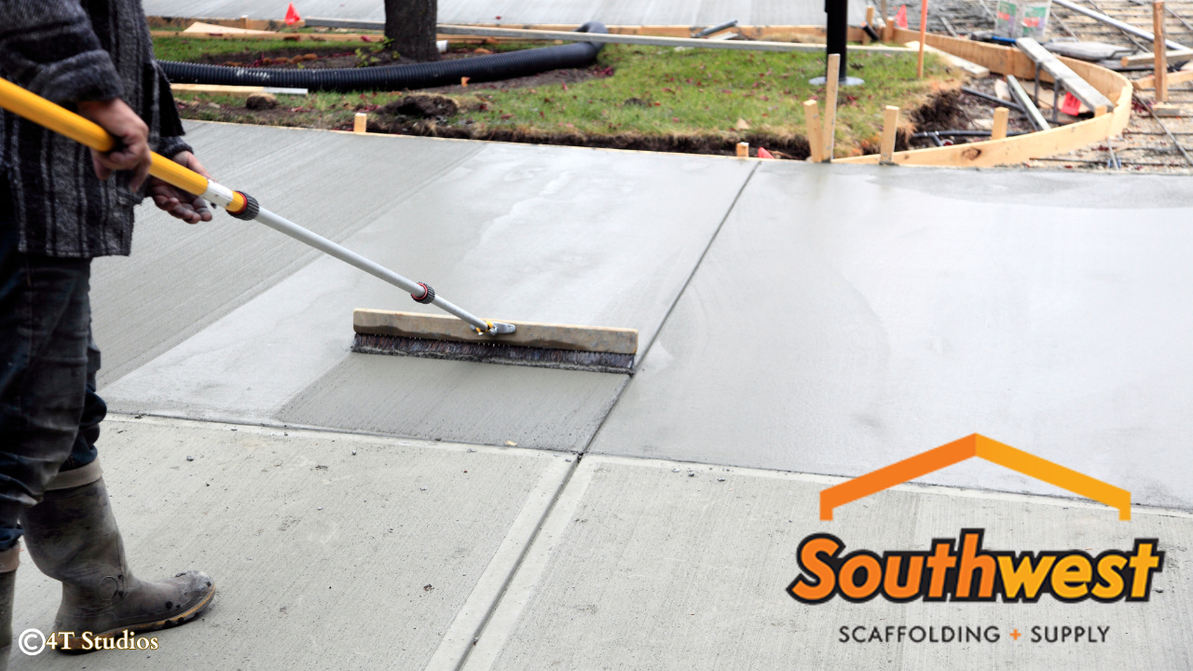
Why Are There Gaps in Concrete?
Concrete cracks.
There. We said it.
Not exactly the opening line the concrete industry would put on a billboard, but it's true.
Concrete is one of the most useful construction materials in the world. We build foundations, highways, bridges, sidewalks, parking garages, warehouses, dams, and entire buildings with it.
It's strong.
It's durable.
And given enough time and the right conditions, it is probably going to crack somewhere.
Which brings us to all those lines, cuts, and gaps you've seen in concrete.
Most of them aren't mistakes.
They're there because the people designing and installing the concrete already know something important:
If concrete is going to move, you'd better give it somewhere to do it.
Welcome back to Why Is It Built Like That?
Today we're looking down instead of up.
Why are there gaps in concrete?
Concrete Isn't as Still as It Looks
A finished concrete slab looks pretty permanent.
You pour it.
It hardens.
That's that.
Except it isn't.
Concrete changes from the moment it's placed.
As concrete cures and loses moisture, it can shrink.
Temperature changes matter too. Materials expand when they get warmer and contract when they cool.
Then there's the ground underneath.
Soil moves.
Moisture conditions change.
Loads get added.
Buildings settle.
Vehicles drive across slabs.
Weather beats on exterior concrete year after year.
Concrete may look like one big solid chunk, but it lives in an environment that is constantly changing around it.
Something has to give.
And concrete isn't particularly good at stretching.
So We Plan for the Crack
This sounds strange until you've worked around concrete for a while.
Sometimes the goal isn't to stop concrete from ever cracking.
The goal is to influence where it cracks.
That's what control joints, sometimes called contraction joints, help accomplish.
You've seen them in sidewalks.
Instead of pouring one long uninterrupted sidewalk and hoping for the best, joints divide the concrete into smaller sections.
On larger slabs, those joints may be formed while the concrete is placed or saw-cut afterward.
The joint creates an intentional weakened plane.
As the concrete shrinks and internal stresses develop, the crack is encouraged to form at that location instead of wandering randomly across the surface.
In other words, we're basically telling the concrete:
If you're going to crack, please do it here.
Concrete doesn't always follow instructions perfectly, because construction materials occasionally have the same attitude as construction workers.
But that's the idea.
Not Every Gap Does the Same Job
This is where things get a little more interesting.
People tend to call every line in concrete an expansion joint.
They're not all expansion joints.
Some are control joints.
Some are expansion or isolation joints.
Some are construction joints.
They may look similar to someone walking across the slab, but they're solving different problems.
Control joints help manage cracking caused by shrinkage and movement.
Expansion or isolation joints provide separation so different sections or structures can move without pushing against each other.
Construction joints often mark where one concrete placement stopped and another began.
Think about a large concrete project.
You aren't necessarily pouring every yard of concrete in one continuous operation.
Work may happen in stages.
Different sections may be placed at different times.
Those transitions have to be planned.
So when you see a line in concrete, it doesn't automatically mean something went wrong.
Sometimes it means somebody thought ahead.
Why Not Just Make Concrete Stronger?
Because strength doesn't eliminate movement.
You can reinforce concrete.
You can design the mix carefully.
You can prepare the base correctly.
You can cure it properly.
You can place reinforcing steel or other reinforcement where the design requires it.
All of those things matter.
But none of them magically make concrete immune to physics.
Concrete is very strong in compression, which means it handles forces pushing against it very well.
It isn't nearly as strong when forces pull it apart.
That's one reason reinforcement and joint design matter.
We're working with the material instead of demanding that it behave like something it isn't.
That's a lesson that shows up all over construction.
Good construction isn't about forcing materials to do what we wish they would do.
It's understanding what they're actually going to do.
Then Somebody Fills the Gap
Of course, leaving an open joint isn't always desirable either.
Water can get into it.
Dirt collects.
Debris works its way down.
In certain locations, water intrusion can contribute to problems below or around the concrete.
That's why many joints are sealed.
Joint sealants need to accommodate movement while helping keep water and debris out.
And here's where maintenance enters the conversation.
Sealants don't last forever.
Neither do the edges of joints.
Traffic, weather, sunlight, chemicals, moisture, and ordinary wear eventually take their toll.
That clean joint installed when the project was new may look very different ten or twenty years later.
Like most parts of a building, joints occasionally need attention.
What Happens When Concrete Can't Move?
This is when things can get ugly.
If concrete expands and has nowhere to go, pressure builds.
Slabs can push against neighboring sections.
Edges can spall.
Surfaces can buckle.
Cracking can develop where nobody wanted it.
You've probably seen sidewalks where one section has lifted or pushed against another.
Sometimes tree roots or soil movement are involved, but temperature, moisture, installation, and joint conditions can all play roles in how concrete behaves over time.
This is also why the details matter.
Putting a line in concrete isn't enough by itself.
Joint spacing, depth, timing, placement, base preparation, reinforcement, concrete mix, curing, weather conditions, and intended use all matter.
A warehouse floor carrying forklifts all day isn't the same thing as your backyard patio.
A bridge deck isn't a sidewalk.
A highway isn't a driveway.
Same basic material.
Very different demands.
Concrete Tells Stories
People in construction learn to look at cracks differently.
A homeowner may see a crack and immediately think:
Foundation problem.
A contractor looks at where it is.
How wide is it?
Which direction does it run?
Is there displacement?
Is it getting larger?
Is it following a joint?
Is water entering?
What's happening around it?
When did it appear?
Not every crack means disaster.
But cracks can tell you something about how a structure or slab is behaving.
The trick is knowing which ones matter.
And sometimes the neat straight crack hidden inside a control joint is exactly the crack we wanted.
The Gap Isn't the Mistake
That's probably the biggest takeaway.
Construction has plenty of gaps that are there on purpose.
Concrete joints.
Bridge expansion joints.
Building expansion joints.
Gaps around certain materials.
Spaces that allow drainage.
Places where different materials need to move independently.
To someone unfamiliar with the design, a gap can look unfinished.
To the person who understands what the material is going to do, that gap may be protecting everything around it.
At Southwest Scaffolding, we spend plenty of time around concrete structures, from new construction to industrial facilities and buildings that have been standing for decades.
And one thing becomes obvious when you work around construction long enough:
Materials don't stop moving just because the project is finished.
Concrete shrinks.
Steel expands.
Buildings settle.
Weather changes.
Loads change.
Time does what time does.
Good construction accounts for that from the beginning.
So the next time you walk down a sidewalk and notice those perfectly spaced lines, take another look.
Somebody didn't forget to finish the concrete.
They knew it was probably going to crack.
They just tried to tell it where.
Recent Posts
-
Why Are There Gaps in Concrete?
Concrete cracks. There. We said it. Not exactly the opening line the concrete industry would put on …Oct 12th 2026 -

Why Do Bridges Move?
There are certain things in life we expect to move. Cars. Elevators. Roller coasters. A bridge carry …Oct 9th 2026 -

Why Do Skyscrapers Sway?
If you've ever been near the top of a skyscraper and thought you felt the building move, you probabl …Oct 8th 2026