



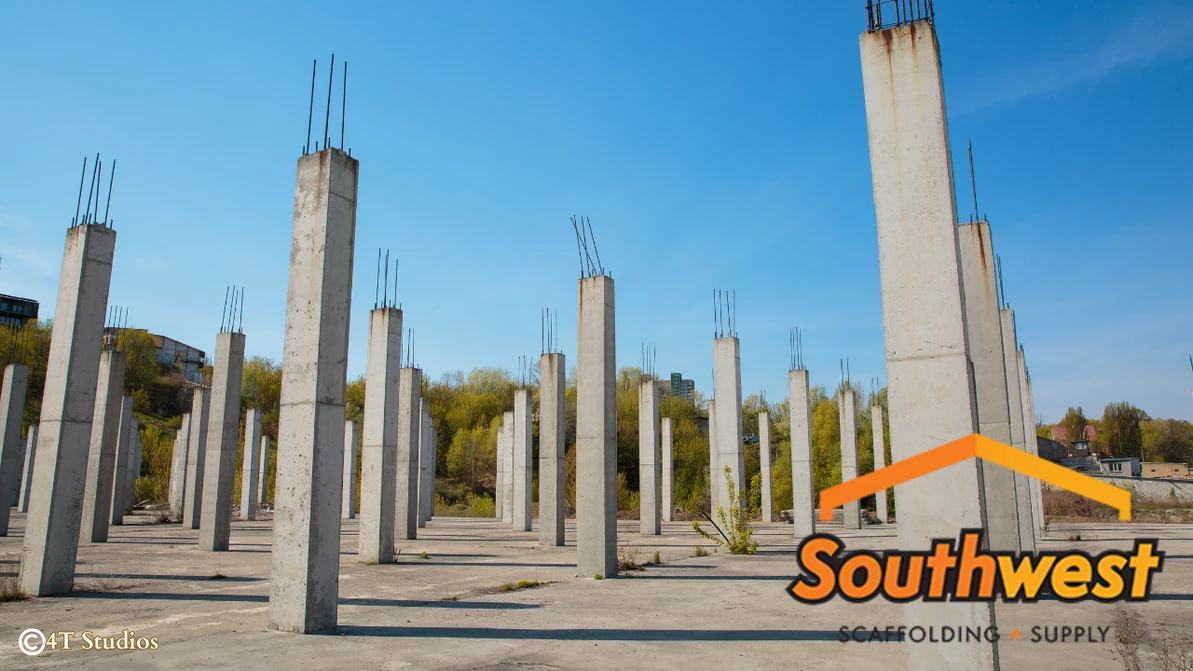
Why Are Buildings Built on Piles?
Most buildings look like they're sitting on the ground.
Sometimes that's a little misleading.
The building you see above ground may actually be supported by foundations extending dozens of feet below it.
Sometimes much farther.
They're called piles, and while they disappear underground once construction is finished, they may be doing some of the hardest work in the entire building.
So why go through all that trouble?
Why not just build a foundation, put the building on it, and call it a day?
Because sometimes the dirt underneath your building has other plans.
Welcome back to Why Is It Built Like That?, where we look at things in construction that make a lot more sense once you understand what they're actually doing.
Today we're going underground.
Not All Dirt Is Created Equal
If you've worked construction long enough, you already know this.
Ground that looks perfectly solid can be anything but.
Soil changes dramatically from one property to another.
You can have clay.
Sand.
Loose fill.
Soft soil.
Wet soil.
Layers of different materials.
Rock.
And sometimes a lovely combination of several of them just to keep things interesting.
A building needs something capable of supporting its weight.
For many structures, a shallow foundation can do that perfectly well.
Footings spread the building loads over the soil beneath them.
But what happens when the soil near the surface isn't strong enough?
You go deeper.
A Building Is Only as Good as What Holds It Up
Think about standing in mud wearing high heels.
Not recommended, but stay with me.
Your weight is concentrated into a very small area.
The heel sinks.
Put on a wide pair of boots and your weight is spread across a larger area.
You don't sink as easily.
Foundations work with the same basic idea of distributing loads, although obviously the engineering is considerably more complicated than choosing shoes.
Sometimes spreading the load near the surface is enough.
Sometimes it isn't.
If the upper layers of soil can't reliably carry the building, engineers may use piles to transfer loads deeper into the ground.
The goal is to reach soil or rock capable of supporting the structure or to develop enough resistance along the pile and surrounding soil to carry the load.
Either way, we're not just hoping the dirt behaves itself.
We're designing around what is actually underground.
So What Exactly Is a Pile?
A pile is a long structural element installed into the ground.
Piles can be made from steel, concrete, timber, or combinations of materials depending on the project.
Some are driven into the ground.
Others are drilled and formed in place.
There are several different pile systems, and choosing one depends on the structure, soil conditions, loads, surrounding buildings, groundwater, equipment access, and plenty of other considerations.
This is where the geotechnical and structural engineers earn their coffee.
Before major foundation work begins, soil investigations can help determine what is actually below the site.
Because "looks pretty solid to me" isn't much of a foundation design.
Although somebody, somewhere, has definitely said it.
Some Piles Reach Stronger Ground
One way piles can support a building is by carrying loads down to a stronger layer of soil or rock.
Imagine weak soil near the surface with much stronger material farther below.
The pile passes through the weaker material and transfers the building load down where it can be supported more effectively.
It's a little like putting long legs under a table until they reach something solid.
Except the table may weigh several thousand tons.
Details.
Others Use the Soil Around Them
Here's where it gets interesting.
A pile doesn't always have to sit directly on bedrock to work.
Some piles develop much of their capacity through resistance between the sides of the pile and the surrounding soil.
As the pile tries to move downward, the soil along its length resists that movement.
Depending on the foundation design, both resistance along the pile and support at the bottom may contribute to carrying the load.
That's why saying, "The piles go all the way to bedrock," isn't automatically true for every building.
Sometimes they do.
Sometimes they don't need to.
The design depends on what's below the building and what the building needs.
Big Buildings Create Big Problems
The taller and heavier the structure, the more load has to go somewhere.
Gravity doesn't care how impressive the architecture is.
All that steel, concrete, glass, equipment, furniture, people, and everything else inside eventually sends loads down through the structure and into the foundation.
Now build that structure in an area with soft or challenging soil.
Suddenly the foundation becomes a major engineering problem.
That's why pile foundations are common in many high-rise buildings, bridges, industrial facilities, waterfront structures, and other heavy construction.
Sometimes the most impressive part of a building is the part nobody ever sees.
Water Makes Things More Interesting
Then there are waterfront projects.
Bridges.
Piers.
Docks.
Buildings near rivers or coastlines.
Now the foundation may have to deal with saturated soil, erosion, changing water conditions, and loads from the structure above.
Piles are especially useful in these environments because they can extend through weaker upper materials into more reliable conditions below.
Of course, installing foundations around water creates its own set of construction challenges.
Because apparently putting a building on solid ground wasn't entertaining enough.
Piles Aren't Just for New Construction
Pile systems can also come into play when existing structures need additional support.
Buildings settle.
Loads change.
Additions are constructed.
Soil conditions cause problems.
Historic structures sometimes need stabilization without simply tearing everything apart and starting over.
Depending on the situation, engineers may use underpinning systems, micropiles, or other deep-foundation methods to transfer or supplement the existing loads.
This can be delicate work.
You're not building underneath an empty piece of property anymore.
You're working around a structure that's already standing.
And preferably you'd like it to remain that way.
Why Not Use Piles Everywhere?
Because construction has another rule that never goes away:
If you don't need to spend the money, don't.
Pile foundations require engineering, specialized equipment, labor, materials, testing, and time.
If the soil near the surface can safely support a building with a conventional shallow foundation, there may be no reason to install deep foundations.
More complicated isn't automatically better.
The right foundation is the one suited to the structure and the conditions below it.
A house and a 50-story building don't have the same needs.
Neither do a warehouse and a bridge pier.
That's why understanding the site comes before deciding how to support what's going on it.
You Can't Judge the Ground by Looking at It
That's probably the most interesting lesson piles teach us.
Construction begins long before we start worrying about what people will see.
A beautiful building can have thousands of carefully designed components above ground.
But every pound of that building eventually has to be supported by something.
And sometimes the first several feet of ground simply aren't up to the job.
So engineers go looking for something better.
Maybe that's stronger soil.
Maybe it's rock.
Maybe the design relies on resistance developed along a deep foundation system.
Whatever the solution, the principle is pretty simple:
The building needs to transfer its loads somewhere capable of carrying them.
At Southwest Scaffolding, we're usually talking about access to the parts of structures people can see.
Scaffolding climbs buildings, bridges, industrial structures, and all kinds of projects above the ground.
But sometimes understanding a structure means looking in the opposite direction.
Down.
Because the part holding up a massive building may not be the concrete foundation you can see.
It may be a system extending deep underground that most people will never know exists.
So the next time you look up at a skyscraper and wonder how something that big stays standing, remember:
Part of the answer may be a very long way down.
Recent Posts
-

Why Are Buildings Built on Piles?
Most buildings look like they're sitting on the ground. Sometimes that's a little misleading. The bu …Oct 13th 2026 -
Why Are There Gaps in Concrete?
Concrete cracks. There. We said it. Not exactly the opening line the concrete industry would put on …Oct 12th 2026 -

Why Do Bridges Move?
There are certain things in life we expect to move. Cars. Elevators. Roller coasters. A bridge carry …Oct 9th 2026