



Why Do Cranes Need Counterweights?
Cranes are impressive machines.
They can pick up steel, concrete, equipment, materials, and loads weighing more than most of us would ever want to calculate while standing underneath them.
But look at a crane closely and you'll notice something interesting.
While the crane is lifting a massive load on one side, there's often a massive amount of weight hanging off the other.
Which seems a little ridiculous at first.
We're already asking the crane to handle thousands of pounds.
Now we're deliberately adding more?
Yep.
Because lifting the load is only half the problem.
The other half is keeping the crane from tipping over while it does it.
Welcome back to Why Is It Built Like That?
Today we're talking about those giant slabs of weight hanging off the back of cranes.
Why do cranes need counterweights?
It Starts With Leverage
You learned the basic principle on a playground.
The seesaw.
Put two kids of roughly equal weight the same distance from the center and everything works pretty well.
Put a 200-pound adult on one side and a 40-pound kid on the other and things change quickly.
But move the smaller person farther from the center and the balance changes again.
That's leverage.
Cranes deal with the same basic principle, except instead of two kids at recess, we're dealing with steel beams, HVAC units, precast panels, masonry materials, equipment, and occasionally loads weighing many tons.
The weight of the load matters.
But so does how far that load is from the crane.
That's where things get interesting.
Ten Tons Isn't Always Ten Tons
Obviously, ten tons always weighs ten tons.
But from the crane's perspective, lifting ten tons close to the crane is very different from lifting that same ten tons much farther away.
The farther the load moves from the crane's center of rotation, the greater the overturning effect it creates.
In crane work, you'll hear people talk about the load radius.
That's basically the horizontal distance between the crane's center of rotation and the load.
Increase that distance and the crane's lifting capacity generally decreases.
That's why a crane might safely lift a certain load at one radius but not at another.
Same crane.
Same load.
Different distance.
Very different situation.
Construction loves doing that to us.
Enter the Counterweight
Counterweights help oppose the overturning force created by the load.
They're positioned on the opposite side of the crane from the lifted load.
As the load tries to pull the crane one direction, the counterweight helps resist that tendency.
Back to our seesaw.
Put weight on one side.
Add weight on the other.
Now we have a much better chance of keeping things where they belong.
Which, when we're talking about cranes, is generally upright.
That's an important feature.
Why Not Just Add a Huge Counterweight?
Seems simple enough.
If counterweight helps prevent tipping, why not add an enormous amount and make the crane impossible to tip?
Because now you've created another problem.
Counterweight is still weight.
The crane structure has to support it.
The ground has to support it.
The carrier, tracks, outriggers, foundation, or tower system has to deal with those forces.
Too much counterweight can create problems of its own.
And cranes don't only operate with the boom pointed in one direction forever.
They rotate.
Loads move.
Boom angles change.
Radius changes.
Conditions change throughout the lift.
Crane stability isn't about hanging the biggest possible chunk of concrete off the back.
It's about having the correct configuration for the lift.
The Ground Is Part of the Crane
This is something people outside construction don't always think about.
A crane doesn't stop at the tires or tracks.
For practical purposes, the ground supporting the crane is part of the stability equation.
All those forces have to go somewhere.
Mobile cranes often use outriggers to create a wider support base and transfer loads into the ground.
Pads or mats may be used to spread those loads over a larger area.
Crawler cranes distribute loads differently through their tracks.
Tower cranes transfer enormous forces through their bases and foundations.
But every crane eventually asks the same question:
Can what's underneath me carry what I'm about to do?
Weak soil, underground utilities, poorly compacted fill, voids, slopes, or inadequate support can turn into serious problems.
You can have the right crane and the right counterweight and still have a bad day if the ground underneath everything isn't prepared for the load.
Tower Cranes Make It Easy to See
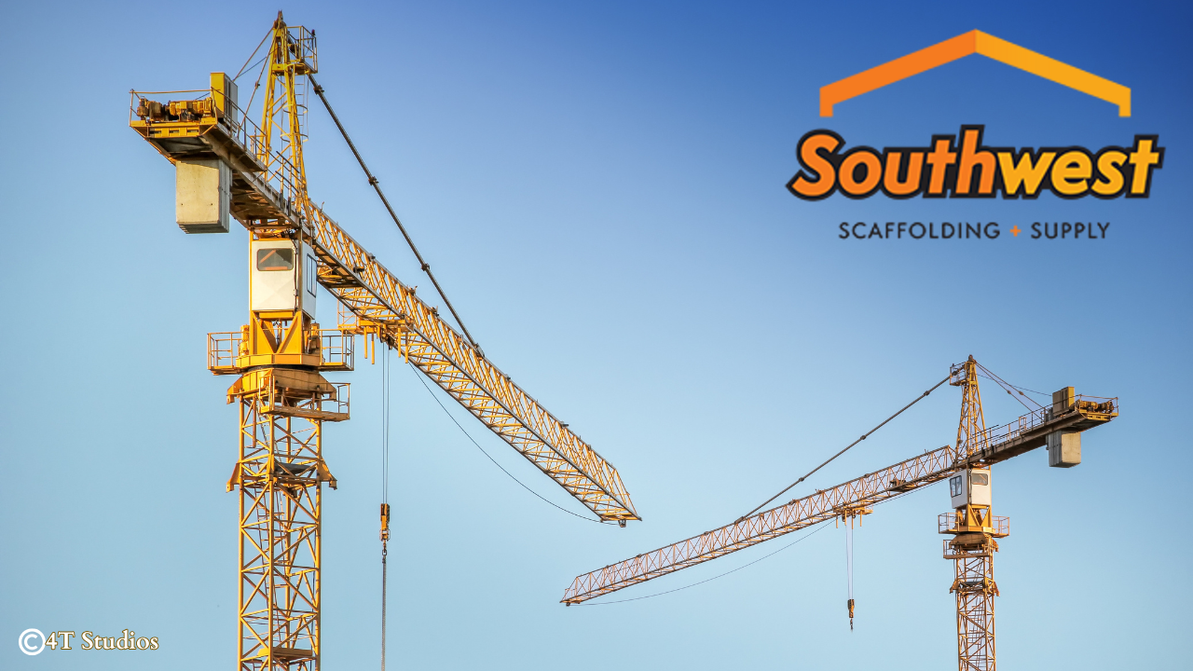
Tower cranes are probably the clearest example of counterweights at work.
Look at one from a distance.
On one side of the tower is the long working jib carrying the trolley, hook, and load.
On the opposite side is the shorter counter-jib.
That's where you'll often see large counterweight blocks.
The whole thing looks almost impossibly skinny compared with the amount of material it can lift.
But the crane is a carefully engineered system.
The tower.
The jib.
The counter-jib.
The counterweights.
The foundation.
The connections.
The lifting machinery.
They all work together.
Take one part out of the equation and the rest doesn't simply shrug and carry on.
Counterweights Don't Make a Crane Invincible
This is probably the most important part.
Having counterweights does not mean a crane can lift anything you can hook onto it.
Every crane has limits.
Those limits depend on the crane and its configuration.
Boom length.
Boom angle.
Load radius.
Counterweight configuration.
Outrigger setup.
Ground conditions.
Attachments.
Wind.
The weight of rigging and lifting equipment.
And, obviously, the load itself.
That's why cranes have load charts.
A crane operator isn't supposed to look at a load and think:
"Yeah, she'll probably pick that."
There is math involved.
A lot of it.
And this is one place where guessing isn't charming.
The Load Can Change Without Getting Heavier
Here's another interesting part.
A load doesn't have to gain a single pound to become a bigger problem.
Move it farther away.
Change the boom position.
Swing it.
Expose a large load to wind.
Change the crane configuration.
Suddenly the forces acting on the crane are different even though the object hanging from the hook weighs exactly what it did five minutes ago.
That's why lift planning matters.
Construction workers tend to think in terms of weight because weight is easy to understand.
"That beam weighs 8,000 pounds."
Useful information.
But the crane needs more than that.
Where is the load starting?
Where is it going?
How far does the crane have to reach?
What happens during the swing?
What's under the crane?
What are the site conditions?
What else is attached to the hook?
There is a reason complicated lifts are planned instead of improvised over lunch.
Wind Likes to Join the Conversation
Of course it does.
Wind can affect both the crane and the load.
A large flat object can catch wind like a sail.
Precast panels, roofing materials, wall sections, signs, and other loads with large surface areas can become difficult to control even when their weight is well within the crane's capacity.
Tower cranes and long booms are also exposed to wind.
Manufacturers establish operating limitations, and conditions have to be monitored.
Counterweights help with crane stability, but they don't cancel weather.
If only construction were that easy.
Sometimes You Need More Crane, Not More Weight
This is another misconception worth clearing up.
When a crane can't safely make a lift at a particular radius, the solution isn't necessarily:
"Add another counterweight."
The answer may be a different crane.
A different crane position.
A shorter radius.
A different boom configuration.
A different lifting plan.
Or another engineered solution.
That's why crane selection happens before the lift.
The goal isn't to find out how close you can get to the crane's limits.
The goal is to choose equipment and a plan capable of performing the work safely.
Balance Is Doing More Work Than It Looks
Construction equipment often makes incredibly difficult work look easy.
A crane smoothly lifts a load.
Swings it across the site.
Lowers it into place.
Everybody goes back to work.
From the ground, the whole thing can look almost effortless.
It isn't.
There are enormous forces moving through that crane.
The counterweights are part of the system keeping those forces under control.
At Southwest Scaffolding, cranes are a familiar sight.
Scaffold components have to reach upper levels.
Equipment needs to be positioned.
Industrial projects involve heavy materials.
Jobsites often require multiple trades and pieces of equipment working around each other.
Understanding what that equipment needs to operate safely matters to everyone on the site, not just the person sitting in the crane cab.
So why do cranes need those giant counterweights?
Because the load hanging from the hook is trying to create leverage on one side of the crane.
The counterweight helps oppose it.
Simple principle.
Very serious engineering.
The next time you see a crane lifting something enormous, don't just watch the load.
Look at what's happening on the other side.
Sometimes the weight that isn't being lifted is what makes lifting the weight possible.
Recent Posts
-

Why Do Cranes Need Counterweights?
Cranes are impressive machines. They can pick up steel, concrete, equipment, materials, and loads we …Oct 26th 2026 -

Why Are Cooling Towers Shaped Like That?
Some structures are instantly recognizable. You can see a massive cooling tower from miles away. Wid …Oct 21st 2026 -

Why Are Water Towers So High?
Every small town seems to have one. A giant tank sitting way up in the air with the town's name pain …Oct 19th 2026