



"The Ground Looks Level Enough"
Construction has several highly scientific measuring instruments.
Levels.
Lasers.
Transits.
Surveying equipment.
Measuring tapes.
And apparently:
Eyeballs.
"Looks level enough."
There it is.
Four words capable of doing an impressive amount of damage when you're about to build something tall, heavy, and occupied by people.
Because when it comes to scaffolding, there's something more important than whether the ground looks level.
Will it stay that way after you put thousands of pounds on it?
Welcome back to Construction Myths That Need to Die.
Today we're starting at the bottom.
Literally.
Level and Stable Aren't the Same Thing
A parking lot can look level.
So can compacted dirt.
Gravel.
Grass.
A construction site.
The shoulder beside a building.
Freshly backfilled soil.
Mud that's dried on top.
All of them can look perfectly reasonable while you're standing there.
But scaffolding doesn't care much about appearances.
It cares about support.
A scaffold transfers its weight, the weight of the people working on it, equipment, materials, and other loads down through its legs and eventually into the surface below.
That surface has to carry those loads.
If one part settles and another doesn't, the scaffold above doesn't politely stay level.
It moves with it.
That's why "looks level" only answers one small part of the question.
The better question is:
What's underneath it?
Scaffolding Has to Put Its Weight Somewhere
Every structure eventually sends its load to the ground.
Buildings do it.
Cranes do it.
Bridges do it.
Scaffolds do it.
We don't always think about scaffolding as particularly heavy because we assemble it one component at a time.
A frame isn't terribly intimidating.
Neither is a brace.
Or a plank.
Or another section.
But keep going.
Now add several levels.
Platforms.
Guardrails.
Workers.
Tools.
Buckets.
Brick.
Block.
Stone.
Mortar.
Equipment.
Maybe weather protection or other components depending on the system.
Suddenly the ground isn't supporting a few pieces of scaffold.
It's supporting an entire temporary structure and everything we've put on it.
That load has to go somewhere.
Soft Ground Doesn't Always Look Soft
This is where jobsites get sneaky.
Ground conditions can change without giving you much warning.
Maybe it rained three days ago.
The surface has dried.
Looks good.
Underneath?
Not so good.
Maybe a trench was excavated and backfilled near the building.
Maybe utilities were installed.
Maybe fill material wasn't compacted the way you assumed.
Maybe water has been running off the roof and saturating one area.
Maybe you're working beside a foundation excavation.
Maybe the ground is firm in the morning and considerably less firm after an afternoon thunderstorm.
The top few inches don't always tell you what's happening below.
That's true for foundations.
It's true for cranes.
And it's definitely true for scaffold.
That's Why Base Plates and Mud Sills Exist
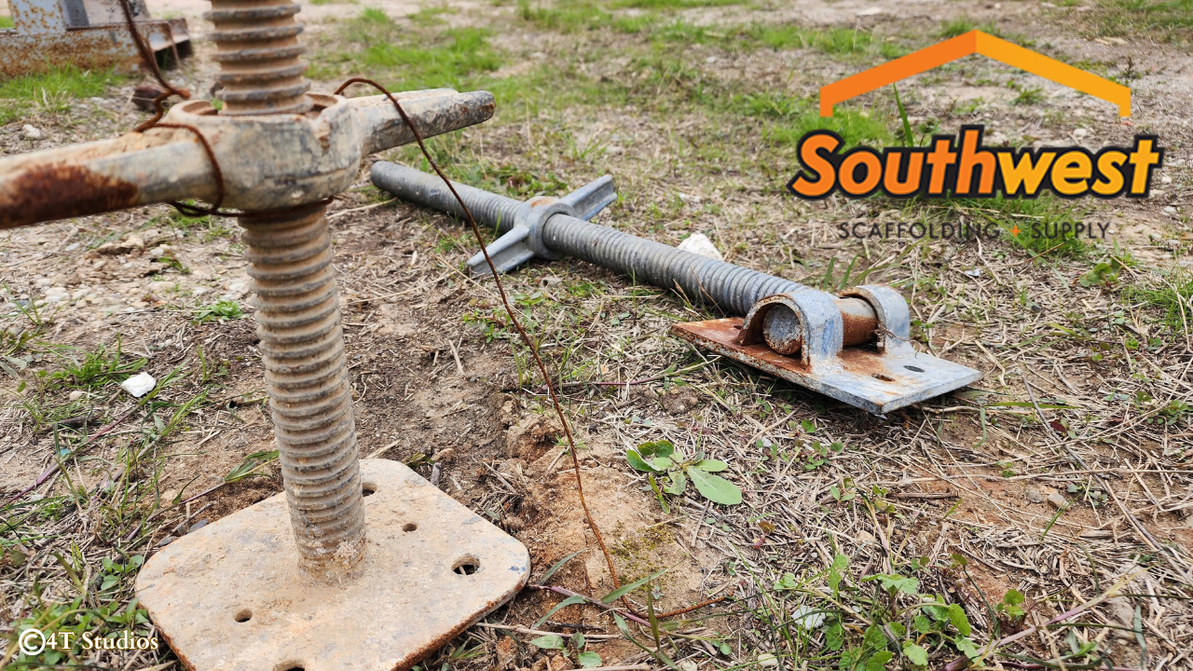
Scaffold legs aren't supposed to simply disappear into the dirt.
Base plates help distribute loads at the bottom of scaffold standards or frames.
Depending on the conditions and scaffold system, mud sills or other adequate foundations may be used beneath them to spread the load over a larger area.
Think back to our discussion about foundations.
Concentrate a lot of weight into a tiny area and the pressure on that surface increases.
Spread the same load over a larger suitable area and you improve how that load is transferred into the supporting surface.
That's the basic idea.
Of course, throwing a random scrap of lumber underneath a scaffold leg doesn't automatically solve every ground problem.
The support itself has to be appropriate.
The soil still matters.
The loading still matters.
The condition of the material still matters.
The entire setup works as a system.
There isn't a magic board that turns bad ground into good ground.
"We'll Just Adjust the Screw Jacks"
Screw jacks are incredibly useful.
They allow scaffold bases to be adjusted so the scaffold can be properly leveled within the limits of the system.
What they don't do is make unstable ground stable.
That's an important distinction.
If the supporting surface underneath one leg is settling, repeatedly adjusting the scaffold doesn't fix the ground.
You're responding to the symptom.
And if the scaffold continues settling after workers and materials are added, you've got a changing structure underneath people who are trying to work.
Screw jacks help level scaffold.
They aren't a substitute for proper support.
A Little Settlement Can Matter a Lot
This is another place where scale matters.
At ground level, half an inch may not look particularly dramatic.
On a taller scaffold, movement at the base can affect alignment and stability throughout the structure.
Scaffold is built from connected components.
Changes at the bottom don't stay politely at the bottom.
They influence what's above.
Now add workers moving around.
Materials being loaded.
Wind.
Access.
Ties.
Bracing.
Uneven settlement.
The whole reason we start with a proper foundation is because everything else depends on it.
You can't fix a bad beginning by building more scaffold on top of it.
Concrete Isn't Automatically the End of the Conversation
This one deserves mentioning too.
"We're on concrete. We're good."
Maybe.
Concrete can provide an excellent supporting surface.
But you still need to know what you're setting up on.
Is it a structural slab?
A sidewalk?
A thin slab over questionable fill?
A suspended slab?
Is there a basement or parking structure underneath?
Are there underground vaults?
Drainage structures?
Utility covers?
Damaged areas?
Edges?
Voids?
A hard surface doesn't automatically mean unlimited capacity.
This becomes especially important when equipment or heavily loaded scaffold systems are involved.
Again, the question isn't:
"Does it look solid?"
It's:
"Can it support what we're putting here?"
Then It Rains
Every contractor just felt that sentence.
You set the site up.
Everything looks good.
Then the weather changes.
Water runs off the building.
The drainage path changes because construction materials are blocking the usual route.
A trench fills.
Soil softens.
Mud develops around the scaffold.
The crew keeps working because the scaffold was fine when it was erected.
But site conditions aren't frozen in time.
Ground that was suitable on Monday may need another look after three inches of rain on Tuesday night.
This is why inspections matter.
We're not only checking whether someone moved a plank or damaged a component.
We're looking at conditions affecting the entire scaffold.
That includes what's happening underneath it.
Frozen Ground Has Its Own Trick
Cold weather can fool you too.
Frozen soil can feel wonderfully solid.
Until it thaws.
Now the surface supporting the scaffold may behave very differently from the one you originally erected it on.
Seasonal conditions matter.
Weather matters.
Drainage matters.
Soil matters.
Construction would be considerably easier if the ground would simply pick a condition and stick with it.
It refuses.
"It Was Fine Yesterday"
There it is again.
One of construction's favorite arguments.
It was fine yesterday.
That's useful information.
It is not a guarantee about today.
Did it rain?
Did someone excavate nearby?
Were more materials loaded onto the scaffold?
Did a vehicle disturb the area?
Did water begin collecting around a base?
Did the temperature change?
Did anything settle?
Conditions change.
That's why a competent inspection doesn't begin with:
"Well, nobody complained yesterday."
It begins with what is actually happening now.
The Taller You Go, the Less Funny Guessing Gets
A low scaffold settling isn't good.
A tall scaffold settling is even less entertaining.
As height increases, proper erection, bracing, tying, loading, access, foundation support, and inspection become increasingly important.
You are building a temporary structure.
Temporary does not mean casual.
That's probably one of the biggest misconceptions surrounding scaffolding.
People see something designed to be assembled and dismantled and subconsciously treat it differently from permanent construction.
But while that scaffold is standing, workers are trusting it exactly like they trust any other structure beneath their feet.
Nobody standing forty feet in the air cares that it'll be gone next month.
They care whether it's stable today.
Good Scaffold Starts Before the First Frame
At Southwest Scaffolding, a scaffold doesn't begin with putting the first frame in the air.
It begins with looking at where the scaffold is going.
Ground conditions.
Building configuration.
Access.
Loads.
Obstructions.
Utilities.
Traffic.
Other trades.
Weather exposure.
The work being performed.
All of those things can influence how the scaffold needs to be planned and erected.
The most impressive scaffold in the world isn't impressive if the foundation underneath it can't support it.
Construction people understand this perfectly when we're talking about buildings.
Nobody says:
"Just pour the foundation anywhere. The dirt looks pretty good."
At least nobody we'd like building our house.
Scaffolding deserves the same basic respect.
Start with something capable of carrying the load.
Build correctly from there.
Keep checking conditions.
And if the ground changes, don't pretend the scaffold somehow didn't notice.
So the next time somebody looks across the site and says:
"The ground looks level enough."
Maybe it is.
But that's not the question.
Level is what you can see.
Stable is what you need to know.
Recent Posts
-

Why Are Cooling Towers Shaped Like That?
Some structures are instantly recognizable. You can see a massive cooling tower from miles away. Wid …Oct 21st 2026 -

Why Are Water Towers So High?
Every small town seems to have one. A giant tank sitting way up in the air with the town's name pain …Oct 19th 2026 -
Why Do Masonry Walls Need to Breathe?
Let's get one thing out of the way first. Your brick wall isn't actually breathing. It doesn't inhal …Oct 16th 2026