


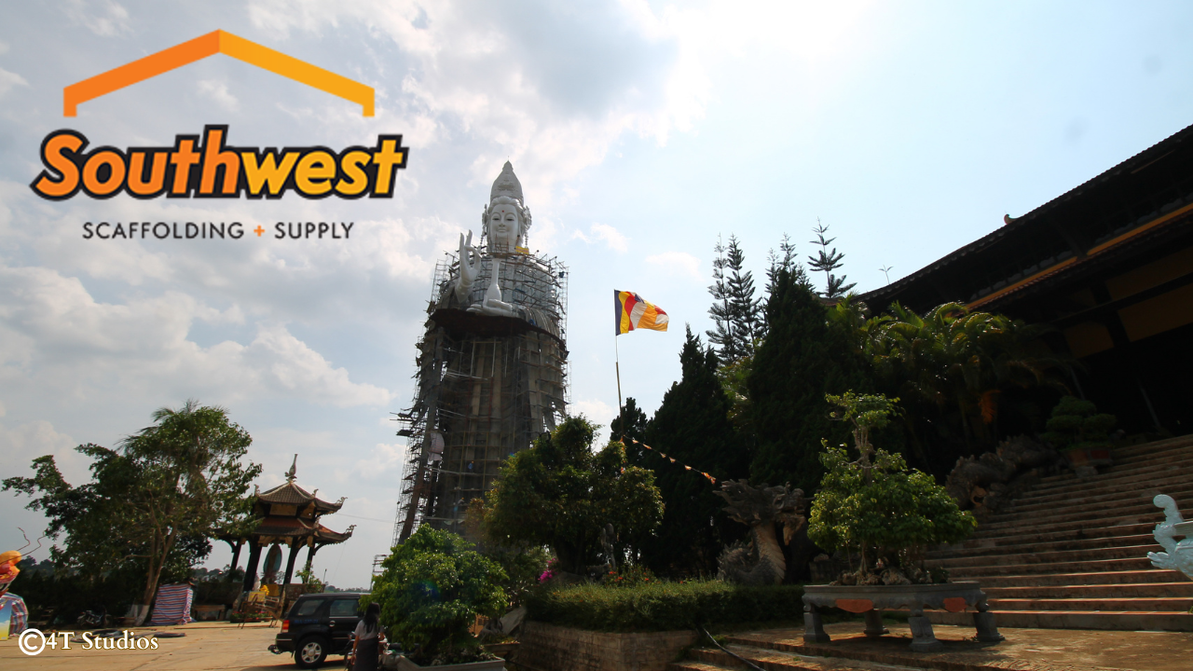
Scaffolding Giant Statues
Scaffolding Giant Statues
Most scaffolding projects begin with a building.
Buildings are usually somewhat cooperative.
They have walls.
Corners.
Floors.
Rooflines.
Relatively predictable shapes.
Then someone asks you to scaffold a 200-foot person.
Suddenly things get interesting.
Around the world, enormous statues rise above cities, mountains, temples, and monuments. Some are made from stone. Others from concrete, copper, bronze, or steel. Many require regular inspection, cleaning, restoration, painting, or structural repairs.
And eventually someone has to figure out how to reach the top.
Welcome back to Scaffolding Around the World.
This time, we're looking at one of the strangest access challenges imaginable.
Giant statues.
People Aren't Shaped Like Buildings
The first problem is geometry.
A typical building gives scaffold designers relatively predictable surfaces.
A giant human figure gives you:
A head.
Shoulders.
Arms.
Hands.
Robes.
Crowns.
Weapons.
Torches.
Decorative elements.
And almost none of them line up conveniently.
A scaffold that works perfectly around the torso may need an entirely different configuration around an extended arm.
As the statue changes shape, the access system has to change with it.
It's less like wrapping scaffolding around a building and more like constructing a temporary building around a sculpture.
Then There Is the Size
It's easy to underestimate the scale of giant statues because photographs don't always provide perspective.
Some monumental statues tower hundreds of feet above the surrounding landscape.
At that point, workers aren't simply working on a sculpture.
They're performing high-rise work.
Wind matters.
Weather matters.
Material handling matters.
Emergency planning matters.
And getting workers from the bottom to the work area becomes part of the project itself.
A repair that appears tiny from the ground might require an entire working platform once you actually reach it.
Where Do You Put the Scaffold?
Supported scaffolding works beautifully when there is suitable ground and a structure that allows a practical layout.
Giant statues don't always provide either.
Some stand on enormous pedestals.
Others sit on mountainsides.
Some are surrounded by public plazas.
Others rise from temples or complex architectural bases.
That means access may require combinations of supported scaffolding, suspended systems, temporary platforms, lifts, or rope access depending on the structure and work being performed.
There isn't one universal solution.
The statue dictates the access.
Where Do You Tie It?
Now things get even more complicated.
Scaffolding requires stability.
On a conventional structure, engineers and scaffold professionals can evaluate appropriate anchoring and tie-in methods.
On a historic statue, attachment options may be limited.
You can't simply start drilling holes into culturally significant stone or historic metal because it makes the scaffold easier.
Surface protection matters.
Historic materials matter.
Existing structural conditions matter.
That can make scaffold engineering particularly challenging.
The temporary structure has to be secure without damaging the permanent one.
Wind Doesn't Care That It's Art
Giant statues are often intentionally placed where they can be seen from a long distance.
Hilltops.
Mountains.
Open plazas.
Harbors.
Elevated pedestals.
Great for visibility.
Not always great for wind exposure.
As scaffolding climbs higher, wind becomes an increasingly important consideration.
Add containment sheeting or protective coverings and the forces can increase substantially.
A scaffold surrounding a giant statue can present a significant surface area to the wind.
That means engineering and weather monitoring become critical parts of the job.
The statue may be standing still.
The air around it isn't.
Restoration Can Be Extremely Delicate
Many giant statues aren't simply large.
They're historic.
That changes the purpose of the work.
The goal may not be replacement.
It may be preservation.
Stone can weather.
Metal can corrode.
Joints can deteriorate.
Coatings can fail.
Water can enter openings.
Previous repairs can create additional problems.
Before anything is repaired, specialists have to understand what they're looking at.
Sometimes the most important decision is knowing what not to touch.
The Public Is Usually Somewhere Below
There's another challenge with famous statues.
People want to see them.
Many monumental sculptures are major tourist attractions.
That means restoration may happen while visitors continue moving through surrounding areas.
Now falling-object protection becomes especially important.
Tools have to be controlled.
Materials have to be secured.
Work zones have to be established.
Deliveries have to be coordinated.
The project isn't happening on an isolated construction site.
It's happening around people who came specifically to look at the thing you're covering with scaffolding.
Not everyone appreciates the irony.
Sometimes the Scaffold Becomes Famous Too
There's something fascinating about seeing a giant statue completely surrounded by scaffolding.
For a short period, the temporary structure can become almost as visually impressive as the monument itself.
Thousands of components may surround a shape that was never intended to support conventional access.
Platforms climb around shoulders.
Scaffold rises alongside heads.
Temporary structures reach toward crowns and extended arms.
Then the restoration ends.
Everything comes down.
And the scaffold disappears from the story.
That's exactly what it's supposed to do.
Temporary Structure, Permanent Purpose
Scaffolding is almost always temporary.
Giant monuments are intended to survive generations.
Yet those temporary access systems make it possible for inspectors, engineers, conservators, painters, masons, metalworkers, and other skilled tradespeople to preserve structures that would otherwise be nearly impossible to reach.
At Southwest Scaffolding, we understand that every structure presents its own access problem.
Sometimes it's a commercial wall.
Sometimes it's an industrial facility.
Sometimes it's a bridge.
And sometimes it's a giant human figure towering hundreds of feet into the sky.
The shapes may change.
The basic question doesn't.
How do we safely get skilled people where the work needs to happen?
Because eventually, even giants need maintenance.
Recent Posts
-
Why Do Masonry Walls Need to Breathe?
Let's get one thing out of the way first. Your brick wall isn't actually breathing. It doesn't inhal …Oct 16th 2026 -
Why Are Buildings Built on Piles?
Most buildings look like they're sitting on the ground. Sometimes that's a little misleading. The bu …Oct 13th 2026 -
Why Are There Gaps in Concrete?
Concrete cracks. There. We said it. Not exactly the opening line the concrete industry would put on …Oct 12th 2026