



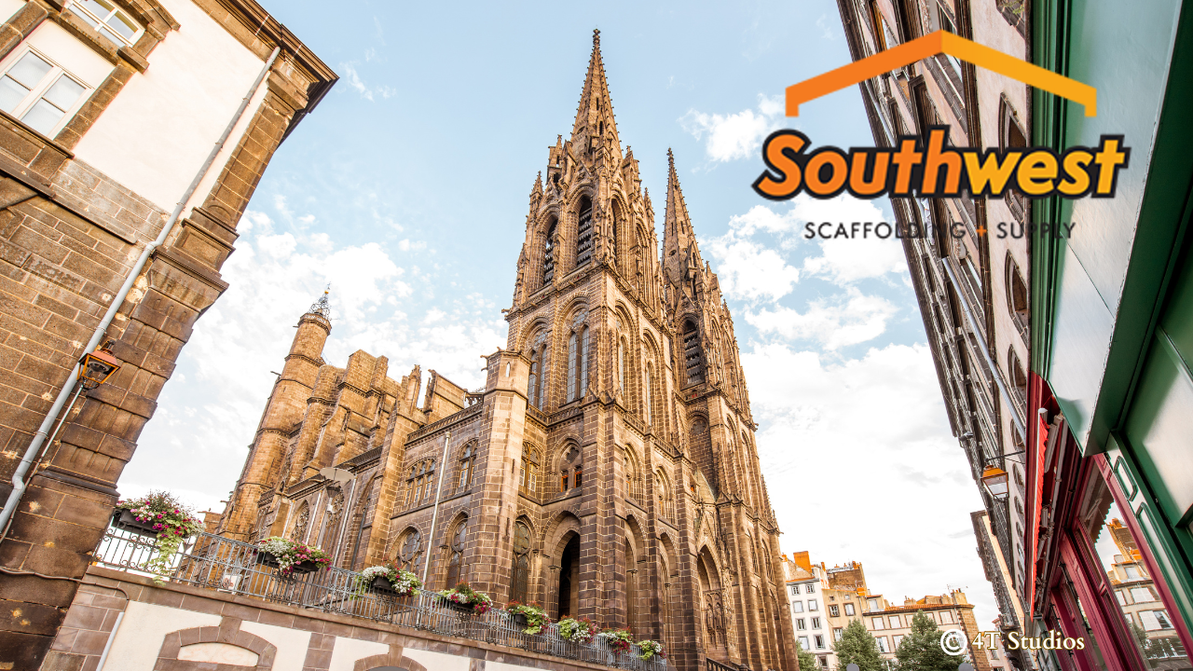
Restoring Europe's Cathedrals
Restoring Europe's Cathedrals
Some construction projects are measured in months.
Some are measured in years.
The restoration of Europe's great cathedrals is often measured in generations.
Long before modern construction equipment existed, master craftsmen built some of the most remarkable structures the world has ever seen. Towering spires, intricate stone carvings, stained glass windows, flying buttresses, and massive vaulted ceilings still dominate the skylines of cities across Europe hundreds of years after their construction.
But even the most impressive buildings require maintenance.
Stone weathers.
Mortar deteriorates.
Water finds its way into structures.
Time eventually leaves its mark on everything.
That's where one of the most fascinating applications of scaffolding comes into play: the restoration of historic cathedrals.
Building Around History
Unlike new construction, restoration projects come with a unique challenge.
You can't simply tear out damaged sections and start over.
Every repair must respect the building's history, architecture, and original craftsmanship.
Many European cathedrals were built centuries ago, long before modern building codes, engineering standards, or construction equipment existed.
In some cases, the materials originally used are no longer readily available.
In others, restoration specialists must carefully recreate techniques that have been passed down through generations of craftsmen.
Before any work can begin, scaffolding must provide safe access to areas that may be hundreds of feet above the ground.
And it must do so without damaging the very structure it's there to protect.
Accessing the Impossible
One of the biggest challenges in cathedral restoration is access.
These buildings were never designed with maintenance in mind.
Steep roofs.
Narrow towers.
Decorative stonework.
Fragile architectural details.
All create obstacles that modern contractors must overcome.
Scaffolding often becomes a custom-engineered solution designed specifically for the project.
Unlike standard commercial construction where scaffold systems may follow familiar layouts, restoration scaffolding frequently requires unique configurations that adapt to the building's architecture.
Every arch, spire, buttress, and tower presents a different challenge.
The scaffold itself becomes an engineering project.
Protecting What Matters
When restoring a modern building, minor damage during construction may be inconvenient.
When restoring a cathedral that's hundreds of years old, damage can be irreplaceable.
That's why restoration projects place tremendous emphasis on protection.
Scaffolding must support workers and materials while minimizing contact with fragile surfaces.
Load distribution becomes critical.
Anchoring methods require careful planning.
Access routes must be designed to avoid damaging historic features.
In many cases, scaffold systems are designed not only to provide access but also to shield portions of the structure from weather during restoration work.
The goal is simple:
Leave the building better than you found it.
Masonry Restoration at Its Finest
Many cathedral restoration projects involve extensive masonry work.
Stone replacement.
Mortar repointing.
Crack repairs.
Water management improvements.
Cleaning and preservation.
This work requires patience and attention to detail.
A restoration mason may spend hours repairing a single area that most visitors will never notice.
That's because the objective isn't simply making the building look good.
It's preserving it for future generations.
The best restoration work often goes unnoticed because it blends seamlessly with the original construction.
The Role of Modern Technology
While many restoration methods remain rooted in traditional craftsmanship, modern technology has become an important tool.
Drones help inspect hard-to-reach areas.
Laser scanning creates detailed maps of structures.
Engineers can analyze movement, stress, and deterioration with remarkable precision.
Yet despite these advancements, much of the work still depends on skilled tradespeople.
Technology can identify a problem.
It still takes experienced craftsmen to solve it.
Lessons From the Past
One reason cathedral restoration is so fascinating is that it reveals the incredible skill of the original builders.
Many of these structures have survived wars, weather, earthquakes, and centuries of use.
Some have stood for 500 years or more.
As restoration teams work on these buildings, they often discover construction techniques that continue to impress modern engineers.
It's a reminder that while construction methods evolve, craftsmanship remains timeless.
Scaffolding as a Preservation Tool
Most people think of scaffolding as temporary.
And it is.
But during restoration projects, scaffolding plays a critical role in preserving permanent structures.
Without safe access, repairs cannot be performed.
Without repairs, deterioration continues.
In many ways, scaffolding becomes one of the most important tools in protecting architectural history.
It allows modern craftsmen to reach the places where preservation begins.
Preserving History for Future Generations
At Southwest Scaffolding, we understand that access is about more than reaching a work area. Around the world, scaffolding helps preserve some of humanity's most significant architectural achievements. From towering cathedrals to historic landmarks, safe access allows skilled tradespeople to maintain structures that might otherwise be lost to time.
Because sometimes scaffolding isn't helping build the future.
It's helping preserve the past.
Recent Posts
-
Why Do Masonry Walls Need to Breathe?
Let's get one thing out of the way first. Your brick wall isn't actually breathing. It doesn't inhal …Oct 16th 2026 -

Why Are Buildings Built on Piles?
Most buildings look like they're sitting on the ground. Sometimes that's a little misleading. The bu …Oct 13th 2026 -
Why Are There Gaps in Concrete?
Concrete cracks. There. We said it. Not exactly the opening line the concrete industry would put on …Oct 12th 2026