


Pulley Systems: How Material Lifting Changed the Job Site
One of the biggest challenges in construction has always been lifting materials.
Brick, mortar, stone, tools, and equipment all have to move vertically before work can happen. Long before modern machinery existed, builders relied on pulley systems to solve that problem.
Simple in design but incredibly effective, pulley systems became one of the earliest tools used to improve job site efficiency.
Ancient Beginnings
The concept of the pulley dates back thousands of years.
Ancient builders used rope and wheel systems to reduce the effort required to lift heavy loads. Early civilizations in Egypt, Greece, and Rome used pulley systems to construct massive structures that would have been impossible to build by hand alone.
Greek mathematician Archimedes is often credited with advancing pulley mechanics, helping demonstrate how mechanical advantage could dramatically reduce lifting force.
The idea was simple:
- Reduce physical strain
- Lift heavier loads
- Improve efficiency
Those same principles still apply today.
Pulley Systems on Early Scaffold Structures
As scaffolding evolved, pulley systems became a natural addition.
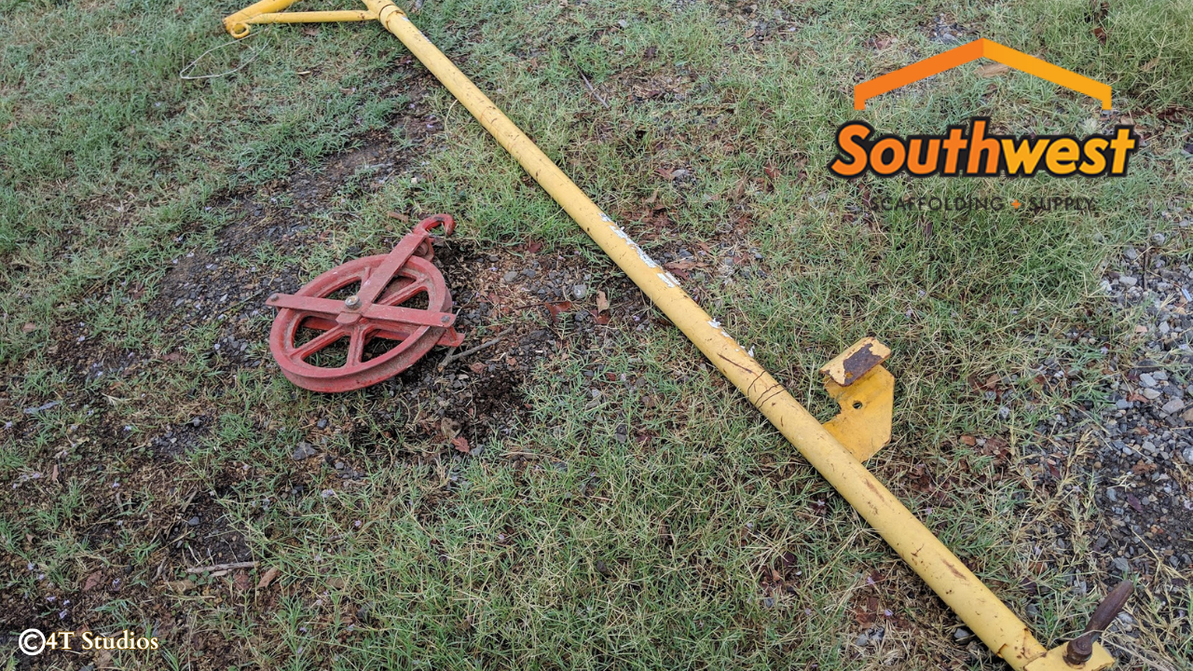
Workers could raise mortar, brick, and tools directly to elevated work areas without carrying everything by hand. This improved production while reducing worker fatigue.
For masonry crews especially, pulley systems helped streamline material handling on multi-story projects.
Without them, crews spent valuable time climbing up and down scaffolding carrying materials manually.
Modern Pulley Systems
Today’s pulley systems are far more advanced, but the purpose remains the same.
Modern scaffold pulley setups are designed for:
- Controlled lifting
- Better material handling
- Reduced labor strain
- Improved workflow
Many systems now use stronger ropes, improved braking systems, and higher-rated components built to handle demanding job site conditions.
Why Material Handling Matters
On busy projects, time spent moving materials is time not spent building.
Efficient lifting systems help crews:
- Maintain productivity
- Reduce unnecessary movement
- Improve coordination
- Lower physical fatigue
This is especially important on masonry projects where materials are heavy and repetitive lifting can slow down production.
Safety Improvements Over Time
Modern pulley systems are also designed with safety in mind.
Organizations like OSHA established standards for lifting systems and scaffold operations to help reduce accidents caused by dropped materials or overloaded equipment.
Proper setup and reliable equipment are essential when materials are being moved overhead.
Southwest Scaffolding
At Southwest Scaffolding, contractors can find scaffold components and material handling equipment designed to support safer and more efficient job sites. Reliable lifting systems help crews move materials faster while reducing unnecessary strain and downtime.
The right setup keeps projects moving and crews working efficiently.
Key Takeaways
- Pulley systems helped revolutionize material lifting in construction
- Scaffold pulley systems improve efficiency and reduce labor strain
- Modern systems are designed for both performance and safety
- Reliable lifting equipment helps keep projects on schedule
Coming Next in the Series
Walk Boards and Planking: The Platforms That Keep Crews Moving
Recent Posts
-

Why Do Cranes Need Counterweights?
Cranes are impressive machines. They can pick up steel, concrete, equipment, materials, and loads we …Oct 26th 2026 -

Why Are Cooling Towers Shaped Like That?
Some structures are instantly recognizable. You can see a massive cooling tower from miles away. Wid …Oct 21st 2026 -

Why Are Water Towers So High?
Every small town seems to have one. A giant tank sitting way up in the air with the town's name pain …Oct 19th 2026