



Historic Courthouse Facade Restoration | Scaffold System
Case Study Series: Real Projects, Real Results
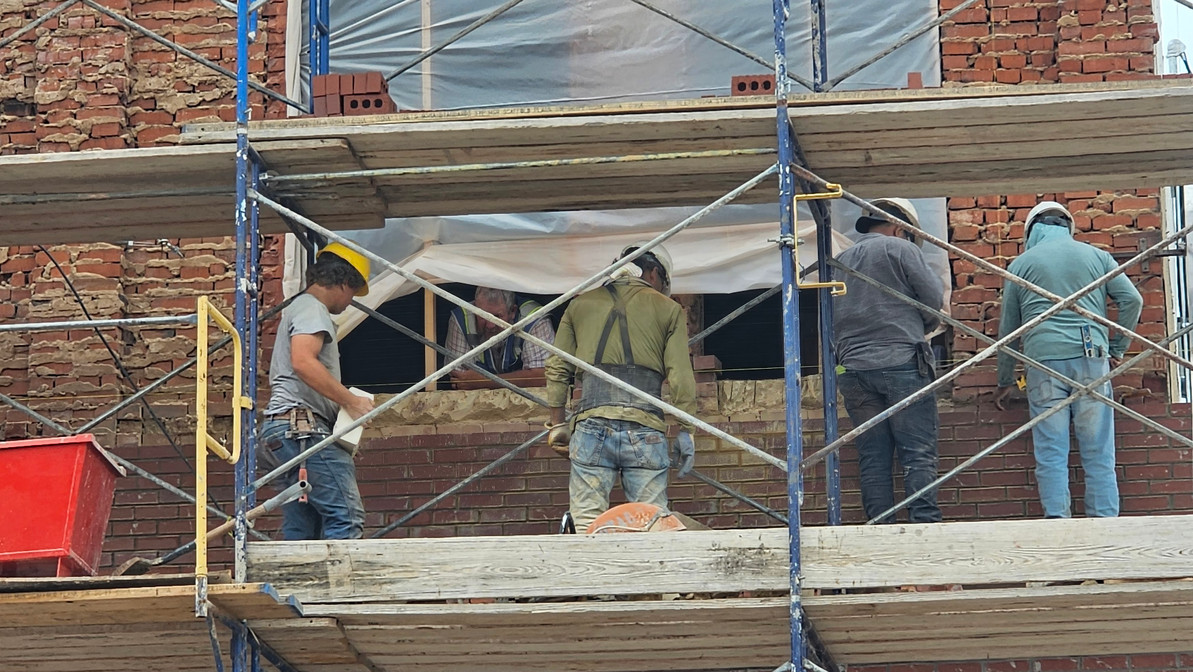
When the Mason County Historic Courthouse in Texas began to show signs of severe weathering, cracks in the stonework, crumbling mortar joints, and dangerously loose facade elements, a restoration crew was brought in to stabilize and repair the structure. But there was one major obstacle: access.
The Problem: Height and Fragility
The courthouse, built in the early 1900s, stood three stories tall with a steep-pitched roof and ornate stone detailing along the top perimeter. A lift or boom simply couldn’t offer the stability or reach needed, especially on the upper cornices and bell tower. Any jostling or sudden movement could damage the fragile masonry.
The Solution: Custom-Built Scaffold System
A modular frame scaffold system was designed and built around the entire structure, tailored to the building’s shape and layout. The system included:
Stair towers for safe and easy crew access
Multiple working platforms at various heights to support masons, tools, and materials
Debris netting to protect pedestrians and landscaping.
Tie-ins and braces to stabilize the scaffold in high wind conditions are common to the area
The Results
With stable, full-perimeter access, the team was able to:
Complete the tuckpointing and stone replacement two weeks ahead of schedule.
Safely restore intricate masonry details on the tower and façade.
Save over $25,000 in projected equipment rental costs by avoiding manlifts and re-staging
Eliminate delays due to weather, since scaffold tarps allow for all-weather work.
Bonus Win: Community Approval
The town loved seeing the scaffold system wrapped in branded mesh, proudly displaying the project partners. Local press and community groups highlighted the restoration’s progress, boosting goodwill and visibility for the contractor and sponsors.
Takeaway:
In complex jobs where safety, speed, and precision matter, a well-designed scaffolding system isn’t just a support structure—it’s a strategic asset. Stay tuned for our next installment in the How Scaffolding Saved This Project series!
Recent Posts
-
Why Do Masonry Walls Need to Breathe?
Let's get one thing out of the way first. Your brick wall isn't actually breathing. It doesn't inhal …Oct 16th 2026 -
Why Are Buildings Built on Piles?
Most buildings look like they're sitting on the ground. Sometimes that's a little misleading. The bu …Oct 13th 2026 -
Why Are There Gaps in Concrete?
Concrete cracks. There. We said it. Not exactly the opening line the concrete industry would put on …Oct 12th 2026