


The History of System Scaffolding
Not all scaffolding is built the same.
For years, traditional scaffolding relied heavily on pipes, couplers, and job-built setups. It worked, but it took time, skill, and constant adjustment to get it right.
System scaffolding changed that by introducing a more predictable and repeatable approach to building at height.
Before System Scaffolding: Labor-Heavy Setups
Early scaffolding systems were flexible, but that flexibility came at a cost.
Pipe and coupler systems required:
- Skilled labor to assemble correctly
- More time to adjust and level
- Constant checking for consistency
Every connection had to be built piece by piece. On larger projects, that added up quickly in both labor and time.
The Shift to Modular Design
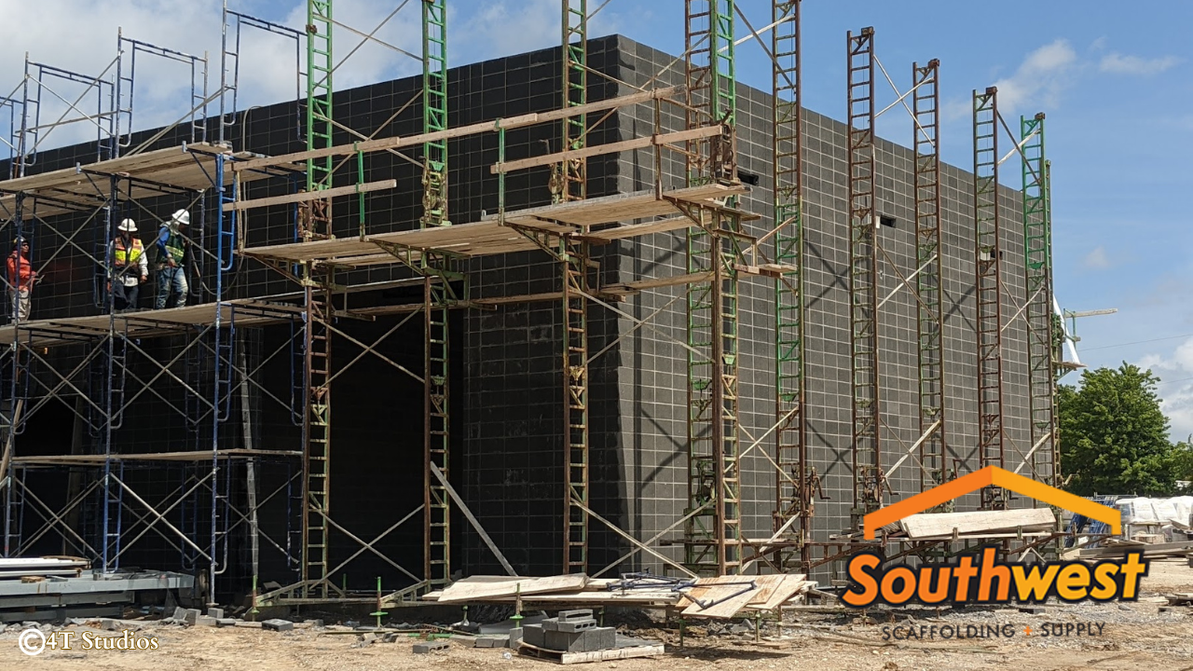
System scaffolding introduced a new concept. Instead of building everything from scratch, crews could use pre-engineered components designed to fit together in a consistent way.
Rosettes, cups, and locking mechanisms replaced many traditional clamps and couplers. This allowed workers to connect horizontal and vertical members quickly and securely.
The result was a system that reduced guesswork and improved reliability across the entire structure.
What “Non-Stop” Really Means
Non-stop scaffolding is about continuity.
Instead of stopping to measure, adjust, and rebuild sections, crews can move continuously as the structure goes up. Components are designed to align and lock into place with minimal effort.
This leads to:
- Faster assembly
- Fewer errors
- More consistent load distribution
It also reduces fatigue. When crews are not constantly adjusting components, they can stay focused on production.
Modern System Scaffolding on Today’s Job Sites
Today’s system scaffolding is engineered for performance.
Manufacturers design these systems to meet strict safety and load requirements set by organizations like the Occupational Safety and Health Administration.
Crews rely on system scaffolding when they need:
- Speed on large-scale projects
- Consistency across multiple levels
- Reliable performance under load
This is especially important in commercial work and masonry applications where timing and coordination matter.
Why Contractors Choose System Scaffolding
The biggest advantage is efficiency.
Time spent building scaffolding is time not spent building the project itself. System scaffolding reduces that lost time.
It also improves predictability. When components fit the same way every time, crews can plan better and avoid delays caused by adjustments or rework.
For contractors, that means tighter timelines and more controlled labor costs.
Where It Fits in Today’s Industry
System scaffolding continues to grow in popularity because it solves real job site problems.
As labor becomes harder to find and schedules get tighter, systems that reduce setup time and increase consistency are no longer optional. They are becoming the standard.
Key Takeaways
- System scaffolding replaced labor-heavy setups with modular design
- Non-stop systems allow crews to work faster with fewer adjustments
- Consistency improves both safety and efficiency
- Modern systems are built to meet strict safety standards
Coming Next in the Series
Rolling Towers: How Mobility Changed Job Site Efficiency
Recent Posts
-

History of Fall Protection: Evolving Construction Safety
Working at height has always been one of the most dangerous parts of construction. Long before moder …May 28th 2026 -

Grout Pumps: Material Delivery Systems in Masonry Work
Masonry work has always depended heavily on material movement. Whether building reinforced block wal …May 27th 2026 -

The history of Rolling Towers
Efficiency on a job site is not just about speed. It is about movement. Before rolling scaffolding t …May 27th 2026