
"We Don't Need Fall Protection for That"
Nobody says:
"Fall protection is important everywhere except exactly where I'm standing."
But construction workers have developed about a hundred different ways to say basically the same thing.
"We're not that high."
"I'm not going near the edge."
"It's only for a minute."
"I've got plenty of room."
"I'm just setting it up."
"I've done this a thousand times."
And eventually:
"We don't need fall protection for that."
For what, exactly?
Apparently, for whatever we're doing right now.
Welcome back to Construction Myths That Need to Die.
Today we're talking about fall protection, and more importantly, the little exceptions we convince ourselves don't count.
Most People Don't Plan to Fall
This seems obvious, but it's worth saying.
Workers don't usually fall because they decided to walk off an edge.
Falls happen because something changes.
A foot slips.
A surface gives way.
A tool catches.
A worker loses balance.
Something shifts.
Someone steps backward.
A ladder moves.
A plank isn't where you thought it was.
A gust of wind hits at the wrong moment.
You trip.
You stumble.
You react to something without thinking.
The whole point of fall protection is that humans occasionally do things we didn't plan to do.
If we could schedule every fall in advance, this would be a much easier problem.
"Steve is falling at 10:15. Everybody ready?"
Unfortunately, that's not how it works.
"It's Not That High"
This may be the most common argument.
People tend to picture dangerous falls as dramatic ones.
Twenty feet.
Thirty feet.
Six stories.
The kind of height that makes your stomach tighten when you look down.
But a fall doesn't have to be spectacular to hurt somebody.
A worker can be seriously injured falling from a relatively modest height.
How you land matters.
What you land on matters.
Whether you hit something on the way down matters.
Concrete is considerably less forgiving than dirt.
Steel, equipment, materials, debris, and tools underneath you don't improve the situation.
The question isn't simply:
"How high am I?"
It's:
"What happens if I fall from here?"
Those are not always the same conversation.
"I'm Not Going Near the Edge"
Maybe not intentionally.
But work has an annoying habit of moving.
The material is over there.
The tool gets set down somewhere else.
Someone needs help.
You step around an obstruction.
You back up to see your work.
The task changes.
Suddenly the safe area you planned to stay inside isn't where you're working anymore.
That's one reason relying entirely on "I'll just stay away from it" isn't much of a system.
People move.
Work moves.
Conditions change.
A proper fall-protection plan accounts for that before somebody gets close enough to discover the problem the hard way.
Fall Protection Isn't Just a Harness
This is another misconception worth killing while we're here.
Say "fall protection" and a lot of people immediately picture a harness and lanyard.
That's part of the picture.
It isn't the entire picture.
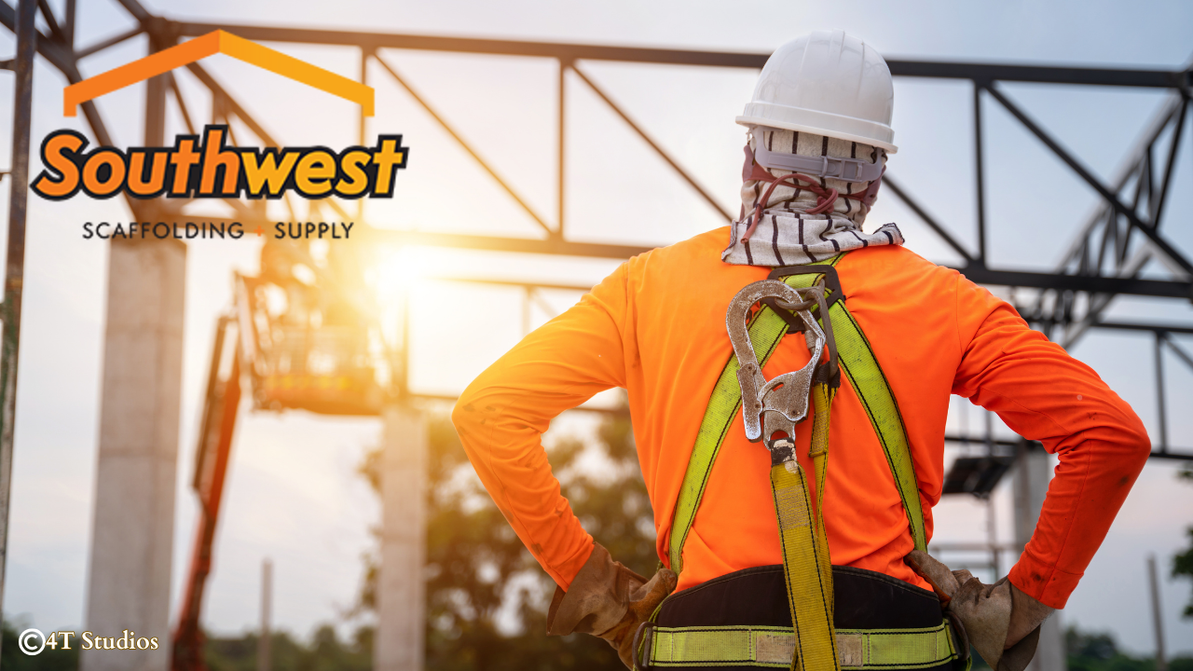
Fall protection can involve guardrail systems, personal fall-arrest systems, positioning systems, travel restraint, covers, properly designed work platforms, and other methods depending on the work and applicable requirements.
Sometimes the best way to protect someone from a fall isn't catching them after they fall.
It's preventing the fall in the first place.
That's why good scaffold design matters.
A properly decked work platform with appropriate guardrails and safe access can remove a lot of opportunities for somebody to make a bad decision.
Good safety often feels boring.
That's a compliment.
The Harness Isn't Magic Either
Then there's the opposite problem.
"I'm tied off."
Good.
To what?
Where?
With what equipment?
How is the system configured?
What happens if you actually fall?
Simply wearing a harness doesn't automatically mean a worker is protected.
A personal fall-arrest system has to be selected, connected, and used properly.
There has to be an appropriate anchorage.
Clearance matters.
Equipment condition matters.
The location of the connection matters.
The potential fall path matters.
Swing hazards can matter.
And after a fall is arrested, somebody needs a plan for getting the worker down.
The goal isn't to turn every worker into a fall-protection engineer.
It's to understand that clipping something somewhere because it looks solid isn't a fall-protection plan.
"But I'm Just Setting It Up"
This one deserves attention, especially around scaffolding.
Sometimes workers think of fall protection as something needed once the work area is complete.
But somebody has to build the work area.
Somebody has to erect the scaffold.
Somebody has to install the protection.
Somebody has to dismantle everything later.
Those stages can create their own hazards.
The fact that the finished scaffold will have guardrails doesn't magically protect the crew while the scaffold is being erected or dismantled.
That's why competent planning matters.
Different phases of work create different conditions.
The safety plan has to match the work actually happening, not the finished version of the jobsite we're imagining in our heads.
Familiarity Makes Heights Feel Shorter
Spend enough years working at elevation and something strange happens.
You get used to it.
A height that once made you cautious starts feeling normal.
You move more naturally.
You're comfortable on ladders.
You're comfortable on scaffold.
You understand your balance.
You stop thinking about every step.
That's part of becoming experienced.
But gravity doesn't care how comfortable you are.
Twenty feet doesn't become fifteen because you've been a carpenter for thirty years.
An open edge doesn't become less open because you've walked beside it every day this month.
Familiarity changes our perception of the hazard.
It doesn't necessarily change the hazard.
That's an important distinction.
The Best Workers Can Still Slip
Construction culture puts a lot of value on skill.
It should.
A skilled tradesperson can do things that look almost effortless because they've spent years learning how.
But fall protection isn't an insult to somebody's ability.
It's backup for the moment when ability isn't enough.
You can have excellent balance and step on something loose.
You can be careful and have a surface fail.
You can have thirty years of experience and get hit by something another worker dropped.
You can do everything right and still encounter something you didn't expect.
Safety systems aren't there because workers are incompetent.
They're there because worksites aren't perfectly predictable.
Production Pressure Shows Up Again
We've already talked about "It's only a quick job."
Fall protection often gets caught in the same argument.
Setting things up takes time.
Getting the right equipment takes time.
Installing guardrails takes time.
Moving access takes time.
Checking equipment takes time.
Planning takes time.
When a crew is behind schedule, those minutes start looking expensive.
Until there's an incident.
Then suddenly nobody is talking about the ten minutes it would have taken to set things up correctly.
They're talking about stopping work.
Medical treatment.
Reports.
Investigations.
Insurance.
Lost production.
Replacement workers.
Schedule delays.
And possibly something much worse than any of those.
The shortcut that saved ten minutes can become the most expensive decision made on the project.
Don't Let the Number Become the Entire Conversation
There are specific fall-protection requirements for different types of construction work, and contractors need to understand the standards that apply to the work they're performing.
But there's a trap in reducing the whole conversation to:
"At exactly what height am I required to do something?"
Compliance matters.
Absolutely.
But good jobsite planning also means recognizing the actual hazard in front of you.
What's below the worker?
What's around them?
How are they accessing the work?
Could they fall through an opening?
Could the platform change?
Could weather affect the work?
Are other trades creating hazards nearby?
Is the system being erected or dismantled?
What happens if someone does fall?
A tape measure doesn't answer all of those questions.
Fall Protection Works Best Before You Need It
That's really the point.
The worst time to discover you needed fall protection is halfway down.
At Southwest Scaffolding, working at elevation isn't unusual.
It's the job.
That means access and fall protection can't be treated like optional accessories added after everything else is figured out.
They have to be part of how the work is planned.
Good scaffolding gives workers a stable platform.
Proper guardrails provide protection at exposed sides and ends where required.
Safe access gives workers a way to reach the platform without inventing one.
And where personal fall protection is needed, it needs to be properly planned and used.
None of that means construction becomes slow, timid, or buried in rules.
It means the crew can concentrate on doing the work instead of improvising how they're going to stay off the ground.
So the next time somebody looks at a task and says:
"We don't need fall protection for that."
There's a better question.
What protects you if something you didn't plan for happens?
Because nobody plans to fall.
That's why we plan for the possibility.
Recent Posts
-
"We Don't Need Fall Protection for That"
Nobody says: "Fall protection is important everywhere except exactly where I'm standing." But constr …Nov 9th 2026 -
It's Only a Quick Job
There may not be a more dangerous unit of measurement in construction than "five minutes." How long …Nov 6th 2026 -
Why Are Manholes Round?
Some construction questions sound almost too simple to ask. Why are manholes round? Because they're …Nov 4th 2026