


Scaffolding Safety minute Episode 3- Access points
If You Can’t Get On Safely, You Shouldn’t Be On It
Let’s start with something simple that somehow gets ignored every single day on jobsites:
If your crew can’t access the scaffold safely… they shouldn’t be on it.
Not “be careful.” Not “watch your step.”
They shouldn’t be on it. Period.
Because access isn’t just a convenience—it’s part of the system. And when it’s missing or done wrong, you’ve already lost control of the job.
The Shortcut That Turns Into the Standard
Access is one of the most overlooked parts of scaffold safety—and one of the easiest to fix.
But instead of fixing it, people work around it.
They climb cross braces.
They hop levels.
They “make it work.”
And give it a day or two, that workaround? It becomes routine.
That’s when it gets dangerous.
Let’s Be Clear—This Is an OSHA Issue
OSHA doesn’t leave this open to interpretation.
If your scaffold platform is more than 2 feet above or below a point of access—safe access is required.
Not suggested. Not “when you get to it.”
Required.
So if your crew is climbing the frame to get up there? You’re not just cutting corners—you’re already in violation.
What Safe Access Actually Looks Like
There are approved ways to do this, and none of them involve improvising.
You’ve got options:
- Portable ladders
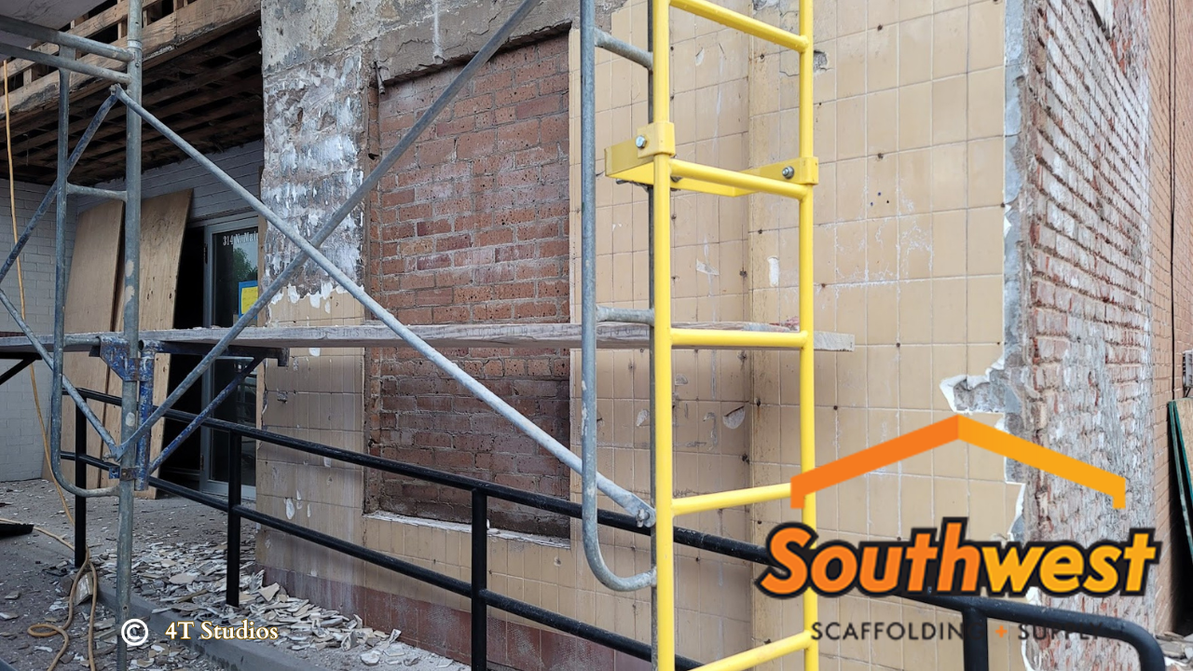
- Hook-on or attached ladders
- Built-in scaffold ladders
- Stair towers
- Ramps or walkways (when applicable)
Pick the right one for the job and install it before anyone steps foot on that scaffold.
Not after. Not when someone complains.
Before.
What Doesn’t Count (Even If “It Works”)
Let’s clear this up, because this is where people start justifying bad decisions:
- Climbing cross braces
- Improvised access
- Jumping between levels
I don’t care how many times someone’s done it without getting hurt.
That doesn’t make it safe. That just means they’ve been lucky.
The Mistakes That Show Up Everywhere
You’ll recognize these:
- “It’s faster to just climb it”
- Ladders missing during initial setup
- Access points blocked, buried, or hard to reach
- Crews creating their own path instead of using what’s there
None of these feel like a big deal in the moment.
Until someone slips. Misses a step. Or loses three points of contact for half a second too long.
That’s all it takes.
Real Talk
Unsafe access doesn’t stay “temporary.”
It becomes normal—fast.
And once it’s normal, nobody questions it anymore.
That’s how people get hurt. Not from the obvious hazards…
From the ones everyone got used to seeing.
If You Want a Safer Jobsite, Start Here
This is one of the easiest wins you’ve got:
- Install proper access before the scaffold is used
- Keep access points clear and usable (not buried in materials)
- Make sure it’s easy to reach—if it’s not, people won’t use it
- Train your crew on how to use it the right way
Because if the safe way is harder, slower, or out of the way?
They’ll find another way.
Why This Matters
You can have perfect guardrails. Solid tie-ins. A textbook build.
But if your crew is climbing up like it’s a jungle gym?
None of that matters.
Access is where safety starts.
And if that part’s wrong, everything after it is already compromised.
Next Up
Episode 4: Inspection Requirements
Because if you’re not checking it, you’re trusting it—and that’s a gamble you don’t get to take twice. :::
Recent Posts
-
The History of System Scaffolding: How Non-Stop Systems Changed Job Site Efficiency
Not all scaffolding is built the same. For years, traditional scaffolding relied heavily on pipes, c …May 8th 2026 -

Risk management - The Cost of Project Delays in Construction: Where Everything Adds Up
Southwest Scaffolding Risk Management Series – Final Delays are one of the most frustrating parts of …May 6th 2026 -

The History of Scaffolding: From Ancient Systems to Modern Job Site Efficiency
Scaffolding is one of those things most people don’t think about...until they’re standing on it. But …May 5th 2026