



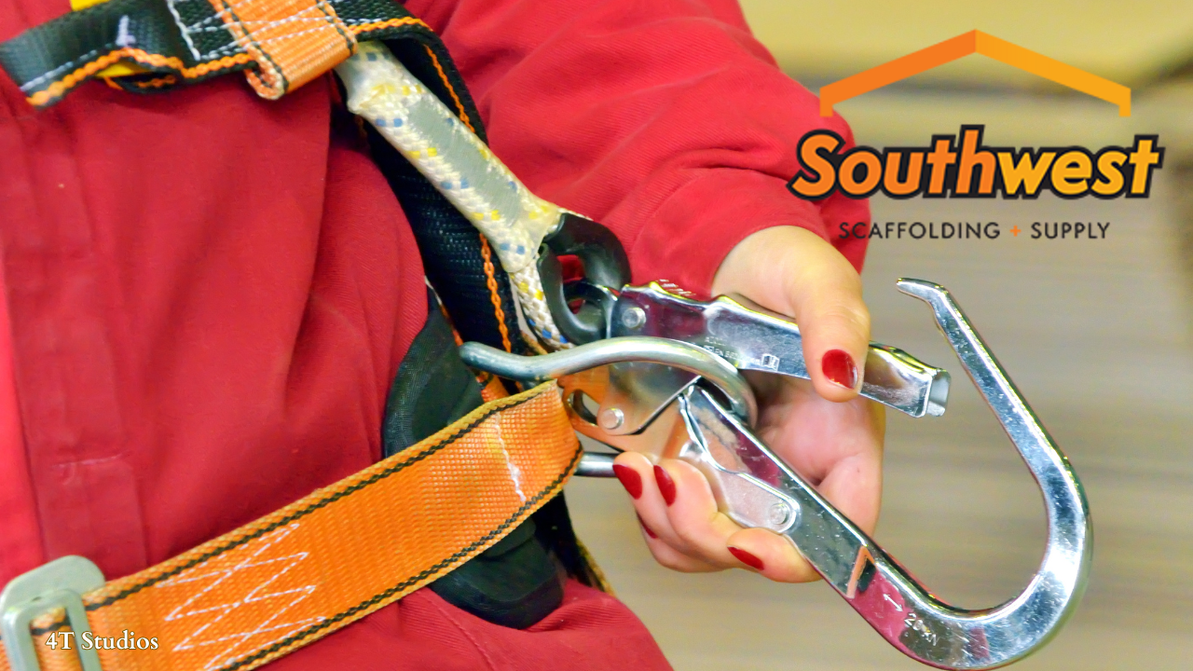
The Physics Behind Fall Protection
When most people think about fall protection, they think about rules.
Tie off above a certain height with the right fall protection equipment.
Wear your harness.
Inspect your lanyard.
Use approved anchor points.
Those rules are important, but they exist for a reason. Behind every fall protection requirement is a simple reality: physics.
Gravity does not care how experienced a worker is.
It does not care how long the task will take.
It does not care if someone has performed the same job safely a thousand times before.
Gravity works exactly the same way every single day.
Understanding the physics behind fall protection helps explain why safety equipment is designed the way it is and why shortcuts can have serious consequences.
Gravity Never Takes a Day Off
Every object on Earth is constantly being pulled downward by gravity.
That includes workers, tools, materials, and equipment.
As long as someone is standing securely on a stable surface, gravity isn't much of a concern. The moment a worker loses footing, however, gravity immediately takes over.
What surprises many people is how quickly a fall develops.
A worker can fall several feet in less than a second.
There is often no time to react.
No time to grab a rail.
No time to think.
By the time the brain recognizes what's happening, the laws of physics are already in charge.
Falling Creates Energy
One of the most important concepts in fall protection is energy.
When a worker is standing on a scaffold or elevated platform, they possess what scientists call potential energy.
The higher they are above the ground, the more potential energy they have.
The moment they fall, that stored energy begins converting into motion.
The worker accelerates toward the ground.
The farther they fall, the faster they travel.
And the faster they travel, the greater the force involved when they stop.
This is why falls from even relatively short heights can cause serious injuries.
The issue isn't simply the distance.
It's the energy created during the fall.
The Real Danger Is the Sudden Stop
People often think falling is what causes injuries.
In reality, the most severe injuries usually occur when the fall ends.
The sudden stop is where the forces become extreme.
Imagine driving a vehicle at highway speed and hitting a concrete wall.
The problem isn't the movement.
The problem is the rapid deceleration.
The same principle applies to falls.
Without fall protection, the body absorbs tremendous forces in a very short period of time.
Bones, muscles, joints, and internal organs are not designed to withstand those forces.
That is why stopping the fall safely is just as important as preventing it.
How a Harness Protects Workers
Many workers view a safety harness as simply something that keeps them from hitting the ground.
While that's true, the real purpose is much more sophisticated.
A properly designed fall arrest system helps manage energy.
When a fall occurs, the system spreads forces across stronger areas of the body, such as the shoulders, chest, pelvis, and thighs.
Instead of concentrating the entire impact in one location, the harness distributes those forces more evenly.
This dramatically reduces the likelihood of catastrophic injury.
The harness doesn't eliminate physics.
It works with physics.
Why Shock-Absorbing Lanyards Matter
A shock-absorbing lanyard is one of the most important components of a fall arrest system.
Its job is to slow the worker's deceleration.
Remember, injuries are often caused by how quickly the body stops.
A shock absorber extends during a fall, increasing the time it takes for the worker to come to a complete stop.
That extra fraction of a second may not seem important, but it significantly reduces the forces acting on the body.
Think of it like an airbag in a vehicle.
The goal isn't simply stopping movement.
The goal is stopping movement safely.
Anchor Points Must Be Stronger Than You Think
Many workers underestimate the forces generated during a fall.
A 200-pound worker can generate thousands of pounds of force during a fall arrest event.
That is why approved anchor points are so important.
The anchor isn't just supporting body weight.
It must withstand the forces created when a moving person suddenly stops.
Improper anchor points can fail even when they appear strong enough at first glance.
That is why fall protection systems should always be connected to properly rated anchorage and connectors.
Swing Falls Are Physics Too
Many workers understand vertical falls.
Fewer understand swing falls.
A swing fall occurs when a worker falls while positioned horizontally away from the anchor point.
Instead of dropping straight down, the worker swings like a pendulum.
This creates additional hazards.
Workers can strike structural components, scaffolding, equipment, or other obstacles during the swing.
The farther someone works away from the anchor point, the greater the swing potential becomes.
This is another example of physics influencing jobsite safety in ways many people never consider.
Understanding the "Why"
One of the goals of this series is to move beyond simply telling people what to do. It's the same reason we broke down what a scaffold load rating actually means.
Understanding why safety systems exist often creates better decision-making.
Fall protection requirements are not arbitrary.
Harnesses are not paperwork.
Anchor points are not suggestions.
They are solutions developed around the realities of gravity, force, acceleration, and energy.
Every component exists because someone studied how falls occur and how injuries can be prevented.
Safety Is Physics in Action
At Southwest Scaffolding, we believe the best safety programs combine proper equipment, quality training, and a clear understanding of the forces workers face every day. Fall protection is one of the best examples of science protecting lives on a jobsite.
Because when a fall happens, gravity doesn't make exceptions.
The good news is that physics can work in our favor too.
When we understand it, respect it, and plan for it, workers have a much better chance of going home safely at the end of the day.
Recent Posts
-

Why Do Cranes Need Counterweights?
Cranes are impressive machines. They can pick up steel, concrete, equipment, materials, and loads we …Oct 26th 2026 -

Why Are Cooling Towers Shaped Like That?
Some structures are instantly recognizable. You can see a massive cooling tower from miles away. Wid …Oct 21st 2026 -

Why Are Water Towers So High?
Every small town seems to have one. A giant tank sitting way up in the air with the town's name pain …Oct 19th 2026