
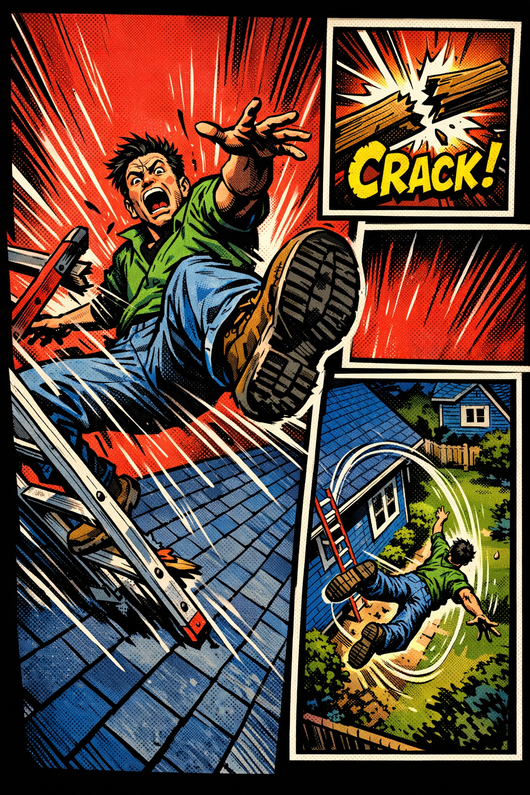
The 5 Biggest Fall Risks on Roofs
Roofing combines elevation, motion, debris, power tools, material staging, and constantly changing weather conditions.
That combination creates one of the highest-risk environments in construction.
Unlike many trades, roofing rarely allows for stable footing. Crews are working at height, often on slopes, while carrying materials, removing old systems, and navigating obstacles. Every movement matters. Every misstep has consequences.
Here are the five most common fall hazards we see on roofing projects — and why they deserve more attention.
1. Improper Ladder Setup
Ladders are one of the most frequently used access tools on roofing jobs — and one of the most frequently misused.
Common issues include:
-
Incorrect ladder angle
-
Unstable or uneven ground conditions
-
Failure to secure the ladder at the top
-
Overreaching instead of repositioning
-
Climbing while carrying tools or materials
Ladders are effective for short-duration access. But when they become the primary workstation, risk increases significantly.
Repeated climbs increase fatigue. Fatigue increases mistakes.
2. Steep Pitch Misjudgment
Not all slopes look steep from the ground.
Even experienced crews can underestimate how quickly footing disappears once they are fully committed to the incline. Architectural shingles, underlayment, metal panels, and dust can all reduce traction.
The steeper the pitch:
-
The less margin for error
-
The faster a slip becomes a fall
-
The more critical proper access planning becomes
A roof does not have to look dramatic to be dangerous.
3. Edge Exposure
Roof edges are constant fall hazards — especially during tear-offs when materials are removed and footing is compromised.
Unprotected edges become more dangerous when:
-
Crews are moving quickly
-
Materials are being staged near perimeters
-
Guardrails or barriers are absent
-
Debris limits clear visibility
One misstep near an unprotected edge can result in severe injury or fatality.
Edge protection is not optional on professional sites. It is fundamental.
4. Debris Underfoot
Roof tear-offs generate loose shingles, nails, felt paper, and fragments. Even small debris can act like ball bearings under boots.
Sliding hazards increase when:
-
Cleanup is delayed
-
Material staging is disorganized
-
Workers are focused on installation rather than footing
Good housekeeping on a roof is not cosmetic. It is protective.
5. Weather Changes
Roofing surfaces change quickly.
Morning dew can linger longer than expected.
Wind gusts can shift balance and materials.
Texas spring storms can move in faster than forecasted.
Even a light mist can dramatically alter traction on shingles or metal panels.
Weather is unpredictable. Preparation is not.
The Pattern Behind the Risk
Most roofing falls do not happen because someone intended to be careless.
They happen because access planning was treated as secondary.
Many of these risks can be reduced — and often eliminated — with proper staging and access solutions.
Scaffolding systems can:
-
Provide stable working platforms at height
-
Reduce repeated ladder climbs
-
Create safer material handling zones
-
Allow guardrail integration
-
Improve workflow efficiency
-
Reduce fatigue across the crew
When crews feel stable, they work more confidently.
When access is strategic, productivity improves.
Safety and efficiency are not opposites.
They are partners.
At Southwest Scaffolding, our goal isn’t to slow your roofing project down.
It’s to keep it moving — safely.
Planning a roofing project this season?
Before the first ladder goes up, contact Southwest Scaffolding for safe, professional roof access solutions.
Because safety isn’t optional.
It’s structural.
Tomorrow: Scaffolding vs. Ladders — Choosing the Right Access Solution.
Recent Posts
-
The 5 Biggest Fall Risks on Roofs
Roofing combines elevation, motion, debris, power tools, material staging, and constantly changing w …Feb 24th 2026 -
The Strange Evolution of Roofs (And Why We Still Need Scaffolding to Build Them)
Roofs are one of the oldest building elements in human history. And somehow… they’ve only gotten mor …Feb 23rd 2026 -
Roof Safety Week Starts Monday !!!
At Southwest Scaffolding, we know roofing is one of the most important — and most dangerous — parts …Feb 20th 2026